Coordinator of Features Development

Photo courtesy of Lilly Tyson
Lilly Tyson is a coordinator for features development at one of the most renown production companies when it comes to horror, Blumhouse Productions. She talks about the winding path that led her to her current job, advice on how to navigate the high-stakes world of film, and insight into the reality of working in an industry that touches everyone in the world.
Name: Lilly Tyson
Occupation: Coordinator of Features Development at Blumhouse Productions.
Okay, but what do you do?
It's so exciting. [I] work on the team that gets to select and make the movies at one of the top horror genre film companies in the industry.
Can you tell me the path of your career so far?
I actually started on a production track. A lot of the time you hear [people] either get a PA (Production Assistant) job or an agency job (mailroom job). I started in this industry in 2015, and I don't think that has changed. Those are two pretty good entrances. I went into being a PA because I didn't want to be in a mailroom. I actually recommend [the mailroom] for the network. I have a wonderful network, I'm very grateful for the people I've met. But, man, people who start in the agency world know everybody. It's incredible.
I got to start on the show New Girl, on season 5. [Then] the UPM (Unit Production Manager), Erin O'Malley, asked me to come over to Tig Notaro’s show, One Mississippi. I was a PA on that until [Erin’s] assistant left to do a startup. I stayed on and was bumped up to being her assistant for that production. When that production wrapped, the assistant who did that startup asked me to [join], so I went to try out something that was more creative, because there were only three of us.
It was not a good time. It showed me a lot–even on a small team, you can still be put in a position of being second-tier, which is really interesting to [see from] people who are my peers. It was only when they said they couldn't pay me anymore [that] I was like, “All right, time for me to do something else.”
Never write off any of the jobs you've had. Everything leads you to where you're supposed to [go]. I landed back in LA after Thanksgiving and was like, “I think I'm done in this industry. I just can't do it anymore. This is so frustrating.” [Then] the Production Office Coordinator, Nick Patapoff at New Girl, wrote to me and said, “There's a corporate job that opened up at 20th Century Fox. They asked me if I had any recommendations and I thought of you.” It was perfect timing. I was leaving that startup, so I interviewed and got it. It was a Second Assistant job [to] Dana Walden and Gary Newman, who were the Co-Chairmen and CEOs of 20th Century Fox.
It was pretty awesome. It taught me desk work, which is what people at agencies pick up in the first two weeks or [they’re] done. I learned that pretty quickly. I was a second assistant, so it was a lot of personal tasks, keeping office flow running. I drove 110 miles a day, easily. My poor car…
I also learned a lot about who I am as a person when it comes to being in a support role. I was told by a [first] assistant, “You need to be 30% meaner to do this job.” I remember thinking to myself, “Then I never want to be in your job.” It was a moment for me where I found this power. I thought, “Play your cards close to your chest. Let people think about you what they want to think. You can't control that. All you can do is do your job really well.” So I did. I hustled really hard for two years.
When Disney and Fox merged, I realized it was about to get a little complicated. Dana was very helpful. I went to her and said, “I love this company, Blumhouse.” She had just met with Jason, Marci, and Jeremy. Jeremy [and] Marci were, at the time, heads of Blumhouse Television. And obviously Jason Blum was Jason Blum. I wrote to Marci and Jeremy's assistant, Raen. At the time, there was no HR, so no positions were even open. [She] was lovely and took a general meeting with me. That opened the door for me.
[Raen] had me meet with every single person at the company. During this time, I left Dana and Gary's office to have a little breather. I got a month where I was talking to all these people, and in that month, [Blumhouse] got HR. [Raen] introduced me to their head of HR, and it just so happened that week they had an assistant who left suddenly. She asked me on the phone, “Have you ever considered casting?” I really hadn't. The people who I knew at 20th who were in casting were very cool. What a way to get more creative-adjacent! I got the call on Thursday, interviewed on Friday. I was walking to my car [from] the interview, and I got the call: “You got the job! You start Monday.”
I hopped into casting very quickly. It's a very cool mix of creative and corporate. I fell in love with the team. I worked with them for six months, and then Covid hit, so we left the office. I was [there] for two and a half years, but two of them were remote. In that time, the industry was changing rapidly. Blumhouse–their deal structure–is very different because it’s all about box office. And all of a sudden, there was no box office anymore. So, they were figuring out what it looked like internally and I was figuring out what I wanted to do. I [hadn’t] asked myself since this whole thing started. So, I sadly had to tell the team, “I have to separate from the industry completely.”
That was 2021. I left Blumhouse, left the industry, left LA. I went to Philadelphia to be with my family. I was like, “I'm taking one year.” I traveled, enjoyed my time, saw friends, got back in touch with what I wanted. I ate up a lot of my savings, but it was great. And then, after a year, [I said] “Okay, I am going to fully dive into the job hunt.”
Layoffs started, the [writers’ and actors’] strike happened, and all of a sudden it was the worst time to be looking for a job. But I kept going. I talked to as many people as I could. During that time, I started coming back to LA a bunch. I had met with Bea Sequeira, EVP of Production and Development, Features, at Blumhouse. She's the one who told me about development. I realized I wanted to be in development, but it's a very hot department, so it's hard to find a job.
I reached out to [my old casting team]. We all [got] lunch together. During it, one of the casting directors [took] a photo of me and sent it to Bea, who was in London on set. A couple days later, I'm in New York at a show. I turn my phone on at intermission, and there's a million texts from casting being like, “Lilly, we [need] your resume!” [They] don't tell me why. Two days later, I get a phone call from Bea, who says, “Our assistant left suddenly. I heard you want to be in development. Would you want to come work with us?” I was like, “100%.”
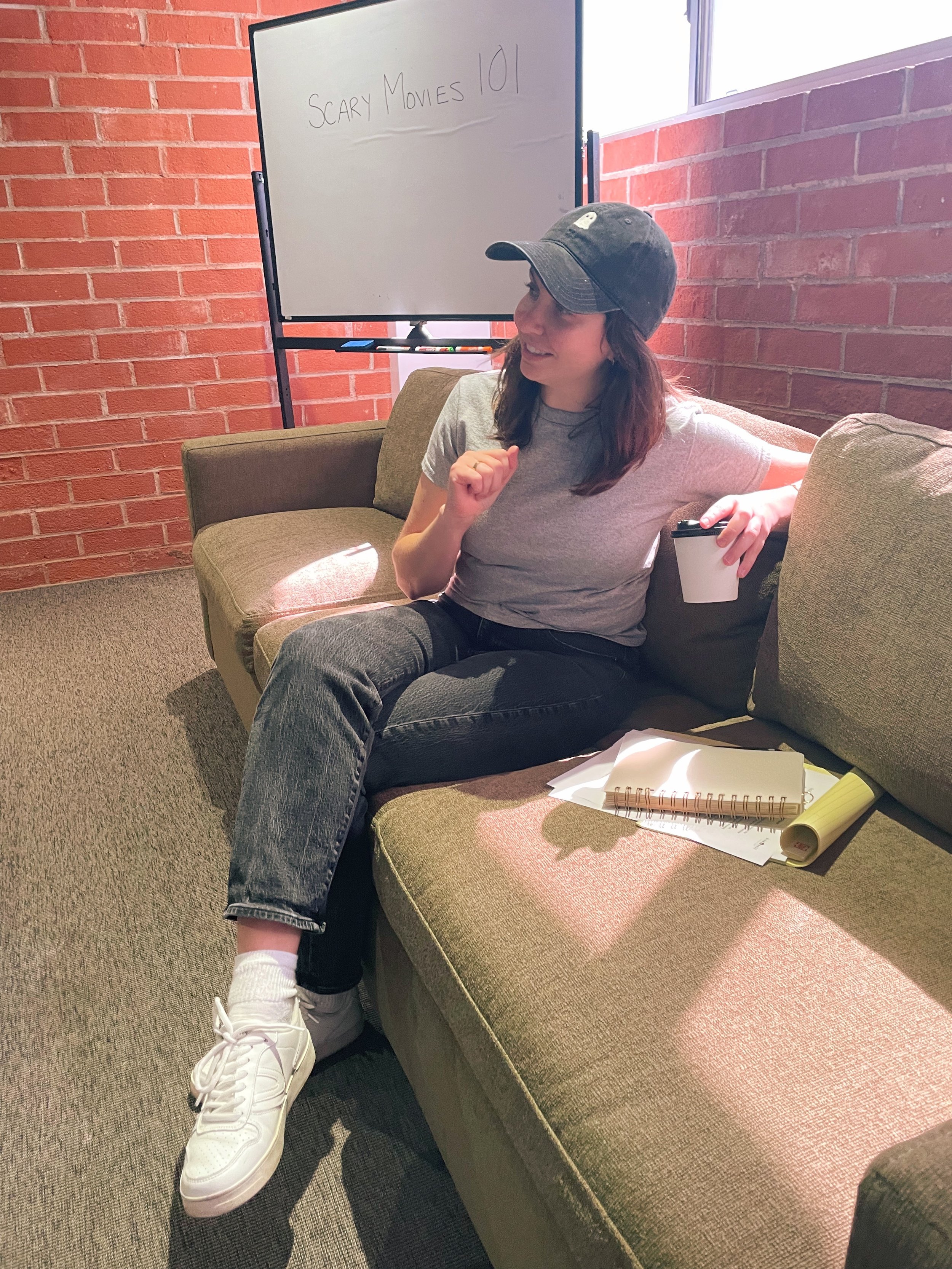
Photo courtesy of Lilly Tyson
What skills do you think predispose you towards this job? And which ones did you pick up along the way?
[Laughing] Having a really healthy dose of anxiety helps so much with thinking about a million scenarios that could go wrong and then having answers for all of them. Then when one happens, you're like, “Great. I knew exactly what would go wrong, and I fixed it.” No joke. It's a little bit like a chess board where you're thinking about all these steps ahead [of time], all these different players, and how people react to stuff. I naturally did that. But putting it into practice in the workplace…that's an “on the job” skill, where you learn the players, you learn who's involved, figure out their reactions...It's not always perfect, but you try and plan for every scenario.
I interned at Final Cut, which is a post-production company in New York City and I loved it. It taught me how being somebody who shows up really well matters. I remember doing the dishes in the kitchen–this sounds so silly–[when] one of the editors came up to me and was like, “Do you understand how many people we have come in here and they're the kids of some important person [who] will not do the work that keeps the office running? I just want you to know that we see it, and I really appreciate the fact that you keep us looking professional by doing these little things.” One time I saw a little drawer was squeaking, so I went and found WD-40 and fixed it. It's little things like that.
[Also] always [giving] people compliments. It is so easy to give people praise. I manage the intern team at Blumhouse with my counterpart Andrew Holding. It is so important to make sure that they understand why what they're doing matters. When they're doing coverage, I'm crystal clear: “Blumhouse is known for giving thoughtful, mindful feedback to creators. When you give those notes, you're making us look really good.” I can picture it so clearly, those moments where I was told what I was doing mattered.
Taking internships is so important because you get to learn things at this level. Doing runs when I was a second assistant, I got to know Los Angeles like the back of my hand. I knew the best times to drive places. I knew the places to get things. You're listening to conversations and hearing where people are meeting for their business lunches and where they take people out for drinks or dinners and how to be a good gift giver. All these little things you learn in those roles are really important in terms of schooling.
I was at a liberal arts school, but in terms of practical knowledge, I did a program in Marlboro, Vermont. Director Jay Craven ran this program where [they] bring in film students [and] you work on an indie set with mentors in each department. I learned so much there, beyond just [the] practical. We had real actresses and actors, like Christian Coulson and Diane Guerrero and Jacqueline Bissett. So [it was also] learning proper etiquette, understanding how a set ran.
What I will say if you're looking to be a producer is: no skill is going to go unused. If you go to business school, you're going to understand something differently than somebody else in your role. Anything you're adding to your toolkit is never going to be a bad thing.
What's something you didn't expect you'd have to do but actually is part of your job?
I didn't know that I would be the information center. I see everything, which means I am asked questions by every department constantly, all day, every day. It's funny, you'd think it would be annoying but I've always loved being the person who gathers information. I want to know everything that is happening. So I really enjoy that side of my job, being the person [who], if I don't have the answer, I know who they can go to to get it. And knowing how all the pieces come together is really satisfying. But that is a huge part of my job, being the person people can come to. And also, it prevents people from going to my bosses. I love being the person people can be like, “I won’t bother Couper, Bea, or Ryan. I'm gonna go to Lilly.”
What kind of tasks fill up the majority of your time?
Hours-wise, probably reading. There's so many scripts. I thought it would be mostly admin, because I work for three of the busiest producers in Hollywood. Blumhouse is one of the few places really making things right now. They are on set constantly, and when they're not on set, they're back in the office trying to make movies get off the ground. A huge part of my day is making sure that I am having the meetings that need to happen, understanding why this meeting has to happen and who the players need to be, making sure people feel included and that the questions are getting answered. But I think in terms of hours I spend, definitely reading and watching and being aware of what is being made, especially in the horror genre right now, because it's a crazy time for horror. People are really into it.
Who are the people you collaborate with most frequently?
Honestly, every department. When I mentioned being the information center, it’s because we work closely with every department. When you're trying to get a movie off the ground, I can't think of a single department [my bosses] don't talk to. I'd say Production and Business Affairs are the two that we are constantly coordinating with.
How much of a creative versus an operational job is it? And if there are creative elements, is that something that you've made happen or is there a natural progression towards more creative aspects in it?
It's naturally a split. Reading is part of the job, however, I have leaned into the creative as much as I can, and my bosses are receptive to that. They’re so supportive of me trying to get in a more creative role and learning those skills. Jason Blum once said, when we called [people] on my team “creative executives,” [that] it's such a silly phrase because every job is creative. Business Affairs is creative. But I think that's also the DNA of Blumhouse. We're very into the “No job is too small.”
What are some of your core admin responsibilities versus some of your core creative responsibilities?
So, admin, the biggest thing is scheduling. You have different kinds of meetings. There's a general meeting, which is all around Hollywood. Everyone is taking generals all the time. It's basically “What do you do? What do I do? How can we work together? Not right now? Okay, great. At least we've met.” Then you have project-specific meetings. Those are top priorities. “We're trying to get this movie going in two months. This meeting about VFX has to happen today.” And then you have pitch meetings, which are usually more pressing because people [want] to get [projects] purchased. Those I will prioritize pretty heavily.
In terms of creative tasks… reading, note taking–which can sound like admin, but by note taking, you are understanding every aspect [of] the movie. If I go into a creative brainstorm with a writer-director and I am taking notes, I'm also there for when they're breaking [closely analyzing] the story. I'm getting to see how they think, what's important. I hear my bosses talk about why something has worked in the past with one of our movies, why it hasn't… That's probably my favorite part of my job: when I get to be in the room for those discussions, because we also deal with iconic IP (intellectual property) I grew up being in love with. Our top ones are probably The Purge franchise, the Insidious franchise, the Paranormal Activity franchise. And then our one offs [are] Get Out, Invisible man, Megan–a second movie is going to come out. Five Nights at Freddy's is a big one. Happy Death Day.
Can you give me a general idea of the development timeline from when a script lands on your desk to when it's produced?
Blumhouse is a unique place. We move so quickly. In a lot of studios, you're going to see a long development process. We don't really do that. We have a script, we have a filmmaker, and we go. There's one movie where the script had been sitting with us since I was in casting, and I remember loving the script. We couldn't find the right filmmaker for it, the right spot to shoot it. And then, all of a sudden, a director saw the script and was like, “I want to make this.” We were up and running in two months. The more frequent thing is, we have a script with a filmmaker that we've worked with or we've been wanting to work with, and we got the green light. I'd say it's pretty quick.
What's your most favorite and least favorite part of your job?
My most favorite is the creative brainstorms. I also really like reading. I love finding a script that's really fantastic, even [if] it's not the right fit for us. [And least favorite…] It's tough because any of the stuff that's difficult is overshadowed by the wins. But as with any office, it's the little tedious stuff in between getting projects off the ground. It can be frustrating when you hit roadblocks and things like that. I also really hate passing on scripts. It's a little bit like in casting, when someone doesn't get a job. You have to get to a point where you're like, “This is business.” It's tough saying, “No, this isn't right.” You just hope it lands somewhere that's correct for it.
Photo courtesy of Lilly Tyson
As coordinator, do you get to weigh in on script decisions?
I weigh in mostly on passes right now. I'll fight for something if I think it's right for us, [but] I have yet to find a script where I am all in, “We have to make this.” It's mostly Bea, Couper, and Ryan who move a product. I haven't gotten the green light [on] one of mine. One time, I said to my boss Ryan, “I think you need to read this. There's a little bit of a sticky hook.” He read it, and said, “Let's talk about it.” We walked through it, and at the end, logistically, it just [didn’t] make sense. That was the one time where I sent him a maybe.
So, normally the ones getting greenlit are going straight to [your bosses, the producers].
Yeah. And if a filmmaker is attached, [it’s] a go. You know, it's like: you have a filmmaker, you have an actor, you have a script, we're moving.
What are possible next steps for a coordinator? Short term and then long term, what does this role evolve to?
The dream is to be a producer like my bosses. I think it's realistic. I remember Couper saying [about my job], “People in this role should be the people you can see yourself producing with in five years.” That's his mindset. They are very much thinking long term. There is so much to learn that finally being on [a] track where I know where I'm going, I don't really care how long it takes to get there: I want to be really good at what I do.
So, if you're on this coordinator path in development at Blumhouse, there's a possibility. What's tough, though, is every company varies so widely that I don't want to come up with a generalization of, “If you're a coordinator here, you'll be a producer,” because some places might not have much upward mobility. But in theory, on this track, you're learning really valuable skills [that] I would hope a company wouldn't view as disposable. It's just a matter of finding the right track. I did years of lateral moves to get to a place where I finally feel like, “I know exactly where I'm going, and I have upward mobility.”
What I'd say to anybody who wants to be a coordinator, who wants to be in the role of running an office, getting things moving, [is]: really work at asking yourself if this is the track you want to be on, because I didn't ask myself that for a long time. And when I finally figured it out, the days that are hard don't matter as much. They don't feel as heavy because you're doing what you want to do.
How does the company you work for impact your job?
I have not worked in development in a lot of other places, but I would say the responsibility I feel isn't minimized by my role. I know how much my bosses care about what they do, and I care just as much. I can't say the same, necessarily, for people who are at a big studio. I can imagine, having worked in a big studio, that a lot of the time even touching a script might not happen for a while, or at least in a way that feels meaningful. When my boss has sent me something and they're like, “why don't you read this with me,” they want to talk about it with me. They want me to bring my thoughts and my ideas and say if something works or doesn't, why it works or it doesn't.
I think that is probably the biggest difference. I am not doing busywork when it comes to creative. Even when it comes to admin, I never feel like I'm being put through the wringer just because. They give me very real, purposeful and specific tasks that are making the movies possible.
Can you talk about differences in being a coordinator for features versus other types of media?
That's a great question. I'm less familiar with [the TV world] now. It's funny because the role of coordinator is also shifting. I've always thought that it was synonymous with assistant. It's not. A lot of the admin stuff is the same. [But] when I go and have a coffee [people] understand I have a bit of a creative say, I have a role in this company. I don't want to give any false information around TV, but we have a TV company, and talking to the coordinator for their team, I think we have a pretty similar role. And unscripted, it's a totally different world, I think.