Flight Attendant
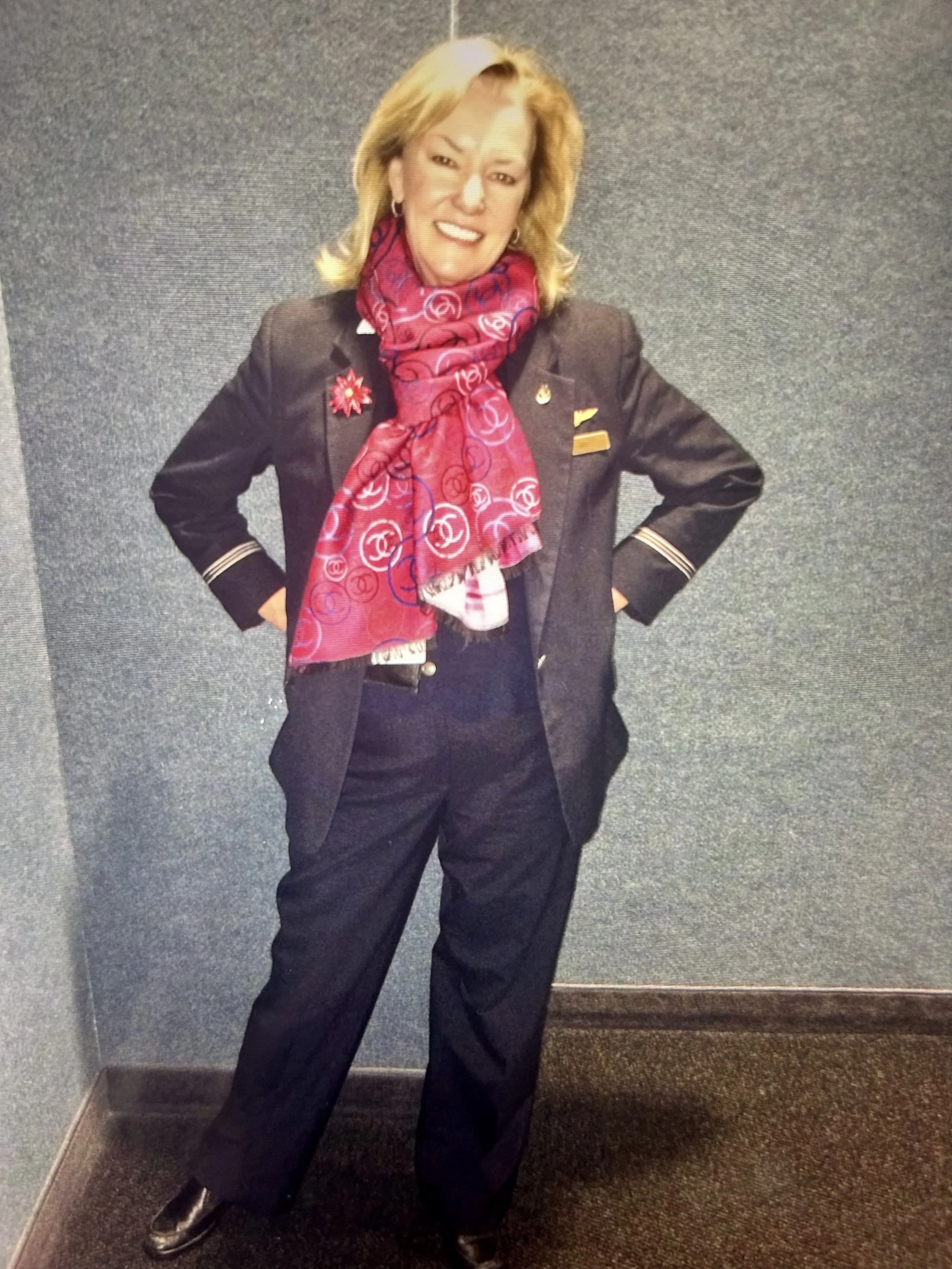
PHOTO COURTESY OF GAIL KNEF
It’s very likely that in your life you’ll interact with a flight attendant and see them at work. But there is so much more to the job aside from in-flight service, and a lot of it happens behind the scenes. So, we spoke to Gail Knef, a now-retired American Airlines flight attendant. She walks us through all the different components of the career: from scheduling, to perks, to training, and more. Read on to find out all about making planes your office.
Name: Gail Knef
Occupation: Flight Attendant
Okay, But What Do You Do?: I help people get to their destination in a safe and comfortable manner.
Can you tell me the story of your career?
I graduated with a business degree in human resource management from University of Alabama and worked in human resources for seven years after college. At the time I was living in Houston, working at an architectural engineering company. That was in the 80s, when the recession happened. I was laid off and looking for other employment.
My husband had a friend from Nashville laying over in Houston, a longtime employee of American Airlines. She said, “Have you ever thought of working for the airline?” I had only flown one round trip. That's how little I had traveled. I sent in an application, and long story short, I got the job. I was amazed!
At the time I was hired and as of a few years ago, they accepted [about] a 1000 applications a day. It's a staggering amount. [And] the pilots too–it's very competitive. I originally started in Dallas, and then we moved to Connecticut after three, four years of flying. I was [based at] JFK, my favorite base of all bases. I loved the people that flew out of JFK. I had no idea this Alabama girl would relate to people from such diverse backgrounds and from everywhere.
I thought, “I'll do this for a while and return to my career in HR.” [But] no one leaves a flight attendant job–almost no one–until they retire. It has changed a little bit now because it’s gotten a lot harder and pay has gotten worse. But as a whole, 90% of the people that started the job did not leave.
Why do you think so many people stay?
Flexibility. I stayed for 35 years, and I would have stayed longer had personal situations worked out. I thought it was so unusual to talk to people that had been there 30, 40 years.
Can you talk about wages?
When I started, starting pay was an average of $28/hour. And then they invented a B-scale pay, which is still the way it is now. Within the year that I started, [pay] went down to $22 or $23 an hour. I think starting now for American Airlines, it’s about $33/hour. Delta is about $35/hour.
But you're not paid until the break releases on the airplane. And there's a lot of costs involved in getting to and from work. [During layovers] the hotels were free and you're paid a stipend, depending on the amount the trip is worth. It's built into your pay to allow for the cost of food, etcetera. The main cost is where you're based. 70% to 80% of people don't live at their base. They drive or fly to get to work. The cost of where you live is paramount.
What does a flight attendant’s schedule look like?
A flight attendant's career is based on seniority. [When] I was hired, they hired so many people behind me, so my seniority was great. It's all about bidding and holding the schedule that you are choosing to fly. In other words, for your seniority, you bid and fly the highest time trip that you can to maximize your hours away from base and [minimize] the amount of trips a month.
You can pick up or drop trips. Say, if London-JFK was a seven hour trip, you'd have to fly four or five Londons to have at least a 70-75 hour schedule. If you flew Rio-JFK, you'd only fly three trips a month. On average, 15 to 17 days away from home. So it depends on what you hold.
It [also] depended on whether you lived at your base [airport] and could get to your base easily. If you were a commuter, you had to bid strictly around how you could get to work. For instance, I lived outside of Hartford, and it was a three hour drive from Hartford to get to JFK. So I would bid trips leaving in the afternoon or at night that got back in the early morning on the fourth day because of driving reasons.
So, the time you're away from home is also contingent on how frequent that route is for the airline.
Right. Your average monthly time is 72-75 flight hours in a month. Everyone tries to get up to 80 or 90. When I had young kids, I just flew my schedule. I'd fly 75 hours a month and not pick up time to make extra money. I would fly weekends so I'd be home for the school week. And then when they got older and started playing sports and the weekends were more important, I worked during the week and stayed home on the weekend.

PHOTO COURTESY OF GAIL KNEF
Do you actually get to visit these places you’re flying to?
Absolutely. The 9 years I flew domestic, I visited all the major cities. The layover times were more generous when I started. By the time I left, they were down to 8 or 9 hours. You don't see anything–you just sleep. I didn't bid for the layover for the first 9 years because the kids were young. I bid for the least amount of time away from home. [And when they were at an age where they] could be home by themselves, I bid for the layover.
I flew to Rio all winter when I lived in Hartford. It was 30 hours: I got my hair done and my nails done and laid at the pool. I had a tan all winter, it was so cheap and affordable, and I only did three trips a month. I saw everything I wanted to see in Rio and Sao Paulo.
In the summer I flew to Europe for better weather. But a lot of the layovers being just 24 hours, you could see one site per layover. And you're not on vacation: you've got to get your sleep for the next flight. So if you went to Milan four or five times in one month, you could see a lot. When I flew with people I liked and wanted to do things with, that was always more fun.
How frequent is the bidding? Is it month to month, week to week, flight by flight?
Monthly. The [flight] schedules don't come out till halfway through the month and you don't get your schedule until, oh, probably the 25th, 26th, 27th of the same month. You can't plan, which is one of the biggest downsides of the job. You can't plan for the next month until you get your schedule. And then, of course, you have the ability to trade trips or drop trips and change up your schedule as best you can.
I don't know if it’s as flexible for them now. The better the schedule that you hold, the easier it is to trade the trip. And you can trade the trips, the position you fly, what cabin you work in along with all of that.
Let's talk about the different categories in flying: domestic vs international, the different cabins you can work in, drawbacks to them…
Everybody had a preference as to what cabin they wanted to work in. We had to bid per position, and American still does it that way. Delta does it differently. They show up at a trip and decide among the crew what positions they want to work. The positions are according to cabin: first, business, or coach. That comes up more in international flying, of course, because you work in wide-body planes. Flying domestic, it was always narrow-body planes so there are 3 or 4 positions only. It's mainly one person in first and then three people in coach.
When I started, in domestic I always wanted to bid for first class because there was smoking allowed in the last row in first and the last 4 or 5 rows in coach, which was miserable. But finally that got taken away.
I started bidding for first because of that reason and kept bidding first, especially for international travel. I loved working in first class because they had so much more [to do]. I loved working in the galley and putting together the meals. We had three-tiered carts that we had to build and send out to passengers. We cut roast in the aisle and served caviar [and dessert] from a three-tiered cart. It was just so much fun. You got $2 extra pay per hour for working in the galley.
International changes greatly from domestic travel. On an 8 hour flight, you usually got at least a 30 minute break to sit down. And then [on flights] over 12 hours, it extended to 2 hour breaks. On the 12-16 hour flights we had a sleep room. On 787s, which is the plane I worked on, you climb up to the sleep room. We had bunks, like ten bunks. You get a 2-3 hour break and then do your last service before landing.
It was very hard at first to adjust to the time zones and demands of the long flights. And then you get used to it. I thought I was gonna have claustrophobia on my first 16 hour flight.
What would you say are some of the key skills that have helped you in this career?
I chose HR in college because I thought I was a people person and I found out I was. I love dealing with people. That is probably one of the biggest traits that [...] somebody in this job [would] need. Everybody thinks of it as a job to travel and to see places. But you really do have to enjoy and want to engage with people.
You also have to be very patient and not expect it to be more than it is. You have to talk to a lot of people that you don't necessarily want to talk to, hear complaints, the same [question] a 1000 times during one trip. “Am I going to make my connection? Can you keep everybody seated so I can get off the plane first?” And the biggest question: “Where are we right now?”
So, patience and wanting to be nice and wanting it to be a good experience for the people that are flying. I found that to be an easy part of the job. Not everyone I flew with did.
What's something you didn't expect you'd have to deal with in this career, but instead found yourself handling?
Do you have children, Nora?
I do not…I am someone's child!
Parenting teaches you patience. I didn't realize that was going to be such a need in this job. Parenting taught me to be a much better flight attendant than I ever would have been. I think it helped every flight attendant I knew who became a parent. For me, personally, it taught me to accept and deal with situations on the plane, the people on the plane, and to not see just the bad aspects of it. Flying is a piece of cake compared to parenting.
What kind of background or training is needed to be a flight attendant?
At the time I was hired, they preferred at least two years of college, and that was about it. You had to fit the height and weight requirements. Now they don't require college. Your first interview was the paper application, and then there was a group interview a month later. And then–I don't know if they go into it that deep now or not–but they did a deep background check. And then you go for a six week training course in Dallas at their headquarters. In 1983, it was six weeks. Now I think it's four.
You have to live at the training center. I shared a room with six other women. You go from 8am to 4pm almost every day. You learn every plane that they fly. You learn the emergency exits, the seating where all emergency equipment is. You learn medical procedures, emergency procedures, emergency exiting on each and every plane. They weighed you weekly. That was a big thing. Now the weight requirement is discriminatory All you have to do is be able to fit through the emergency exit.
You have to go back annually for emergency professional training. You can get fired if you don't pass that day's training, which is rare, but some people do not. When I started, they let go of at least 20% to 25% of class. You're given weekly tests that you have to pass with 85% [minimum grade]. At the end of the training, you're given a test that you have to pass with a 90% [result].
How did you diffuse tense situations on planes?
[You have to] listen. Don't do the majority of the talking, empathize with their situation, and then offer feasible solutions if asked. Not if it's not asked. Simply listening and being invested makes them feel like you understand their situation. [Show] empathy to someone: that's all they need to be at rest, to be comforted. Empathizing gets you so much further. That alone diffuses any situation, especially those on the airplane. The best flight attendants know how to diffuse, not instigate.
Okay, but what do you do?
I'm thinking about how I explained it to Jamie, [my daughter]. She was probably unaware of what I did, except that I just left. That's the only thing she thought about at 10 when she saw me putting on that navy [uniform]. Describing it to her was simply, “Mommy works just like everybody else, but I drive to my job and then I get on an airplane. And because I get on an airplane, I have to fly somewhere [...and] then mommy flies back and drives to you and I’m home just like everybody else.” But, basically, I help people get to their destination in a safe and comfortable manner.