Head of Customer Success & Founder of Axe Company
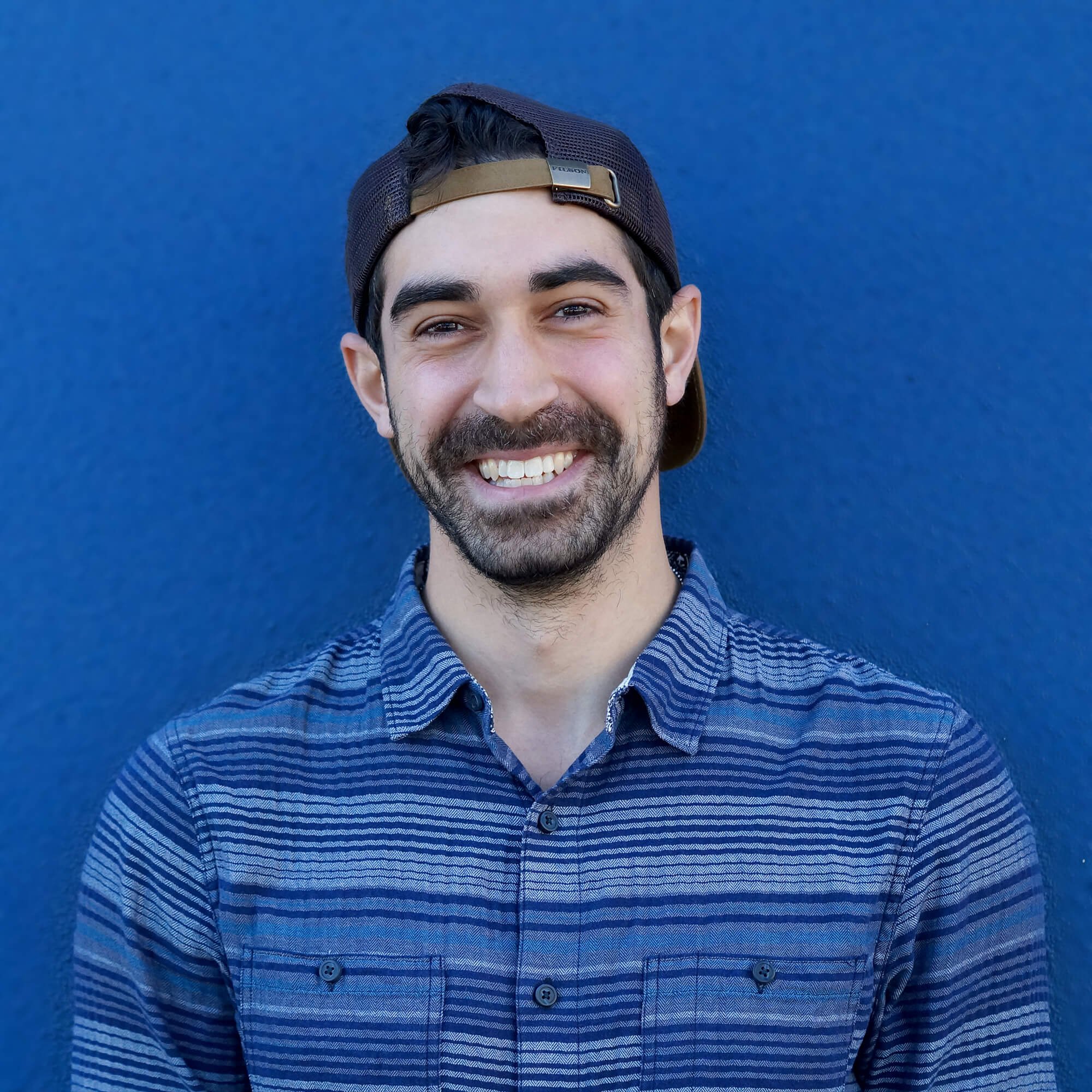
Photo courtesy David George
Ever wonder what it’s like to balance a high-stakes tech job with a side gig that’s a little more... hands-on? Meet David George, who spends his days solving customer crises and his evenings crafting axes. But this isn’t just a hobby—it’s a real business he’s running at the same time. We sat down with him to talk about what it’s like running two completely different careers, how he juggles tech and tools, and what keeps him inspired to keep chopping (pun intended). Let’s dive in!
Name: David George
Occupation: Head of Customer Success and Founder and Head Creative at Motor City Axe
Okay, But What Do You Do?: In my day job, I spend a lot of time building relationships, networking, and talking to people to make sure that they are fully utilizing the tools that are available in the platform for the website that I work for. Then I have my own side business where I get to be more creative. I spend a lot of time working with my hands, playing with sharp objects, and crafting tools and axes that hopefully you and your grandchildren one day will utilize.
What is your official job title?
At Great Recruiters, I am the Head of Customer Success. [I’ve] been there five years. And then with Motor City Axe, which is the side business, I don't really have an official title because it's mostly me. If somebody asks, I usually say Founder and Head Creative.
What does Customer Success mean at this company and in this role?
Great Recruiters is an online reputation management tool designed specifically for staffing and recruiting firms. Our elevator pitch is essentially helping staffing firms elevate what we consider their two most important assets, one being their people and the second being their brand. My role boils down to the onboarding, retention, renewal, and account management of the staffing firms that utilize our platform. In addition, being a small team, I do some user testing on the development side of things as well.
[It’s] like Yelp for the staffing industry. Let's say, for example, I was the recruiter and you were my candidate, and I'm trying to find you a job. I would say, “Hey, great talking with you. Going to get you submitted to this travel nurse position, and in the next day or so, you may receive a request to leave me some feedback. I'd appreciate [it] if you took the time to do that.” The candidate, you, fills out a review about working with me that comes into our platform. My managers can see how my candidates perceive working with me [as] operational internal feedback. We [also] have a public-facing side of the business where from the recruiter's seat, I can share a profile page about myself that has my reviews on it. I can share testimonial cards and social and digital assets to help increase that recruiter's online presence and trust and transparency in the workplace, which is lacking with recruiters today.
That's really cool because recruiting does feel very opaque. If you’re looking for a recruiter to work with, how are you supposed to know if someone's cousin's friend will be helpful?
Yes. That's why on the profile page, we have a whole section of who you are, why you love your job as a recruiter, what you do outside of recruiting, to humanize who these people are. When Adam Conrad, the founder, came up with the idea, he was running a staffing firm and [was] like, “I have a great group of recruiters here. When you Google ‘recruiters are’ [it] autofills ‘untrustworthy, terrible, not someone I would work with’. It was all negative perception online and he wanted to do something to change that.
Can you walk me through your career to date?
I graduated from Michigan State in 2009 with a bachelor's in advertising. The economy and job market were not great at that time. I booked a one way ticket to Northern Ireland and spent some time just hanging out over there and living with my friend David –Irish David, we call him. Then [I] got an email from a guy [for whom] I used to babysit his daughters. His investment firm had purchased a company and they were looking for someone to manage game day sale operations at Michigan State. So, I came home. It was called Live Sports Radio. If you're at a sporting event and you bring your own radio, [it] has a 5-15 second delay on the feed. If you're watching the play, you hear it up to 15 seconds later, and it doesn't line up. The product we had at the time was a live, no-delay feed so you could watch and listen to the game at the same time. I started just at Michigan State, and then I jumped into a full time role with that company, doing event marketing and traveling to a bunch of different sporting events for those folks at different NFL, NHL, PGA, NCAA events throughout the country. Turns out [they] were hemorrhaging money, and I moved on from there.
I worked at Quicken Loans for a year, doing event coordination on their internal operations. I was planning internal events and parties for, at the time, I think they had about 5- 10,000 employees in Detroit. That just wasn't for me. It was too big, and I didn't like the team I was with and didn't know what I wanted to do career wise. I then worked at Moosejaw Mountaineering for two years in a sales and customer service role. I looked at it more as a job rather than a career, because it provided me flexibility. If I didn't want to work, I could say, “Hey, I'm taking this week off.” After that, [I] jumped over into [a] nonprofit. It was called Humble Design. I was doing fundraising and event coordination for them. Our mission was housing and furnishing the homes for individuals who had recently acquired a job and were getting back on their feet and coming out of homeless and abuse shelters, but didn't have enough funds to furnish the home that they just got. So we would go in with donated items and furnish the kid’s bedrooms with toys and games, and sometimes their first mattress. I worked there for two years.
In the meantime, I was also doing some side event coordination for a different charity, planning their summer beer festival at the Royal Oak Farmers market. Then [I] ran into someone, unfortunately, at a funeral. He was working at the time for Crowdrise, which was an online fundraising platform specifically designed for nonprofits. Turns out my mentor from Moosejaw now worked at Crowdrise [too], so I had a couple connections there and ended up working at Crowdrise for about eight months. Then GoFundMe came in and purchased Crowdrise. In total, I was there for three years between Crowdrise and GoFundMe, but [then] HR showed up from California and said, “Hello, we are shutting down this office today.” [They] laid off about 40 of us. The founder of Moosejaw was the same guy who started Crowdrise. His name is Robert Wolfe and I messaged him, and he connected me with what is now Great Recruiters. His childhood best friend is one of the main investors behind [it] and [that] is how I landed the position there. It's all been connections and who I know and who I've met.
You've done a very good job leveraging connections!
Yeah. I like to think that I am decent with people and relationship building, and every job I've ever had is basically from someone that I have worked with [or] helped at some point. I think that's very important. There was a post on a Michigan state alumni group on LinkedIn, and it was, “As school is starting, what is one bit of advice you would give to incoming college kids?” And I said, “You never know where a connection will lead [from] meeting someone in the cafeteria, sitting next to somebody in class, joining a group. Put yourself out there and maintain those connections.”
What type of training and skill sets are needed to be a Head of Customer Success?
When I worked at Moosejaw, it really helped my communication and interpersonal skills. I was doing phone support, email support, chat support, working on the returns department. At the end of the day, one of the things we always said was, “the customer is always right.” While I don't 100% always agree with that, at Moosejaw, that was the goal, to make the customer happy, want to come back, make sure they [got] the right product in a timely fashion. I think that built a foundation for moving into customer success, because at Crowdrise and GoFundMe, I was doing customer success with nonprofits. So, instead of working for just one nonprofit [like] at Humble Design, I had a handful of organizations under my umbrella that I was helping with their online fundraising events.
One [skill] is communication. You have to enjoy and want to talk to people. You have to at least have a bit of [an] understanding of the industry. Coming from a nonprofit and then being able to help a bunch of nonprofits played well. And in the past, I never got a job from one, but I've worked with and talked to a handful of recruiters. I think that kind of experience played into it. A lot of my job is the onboarding and training, and then the relationship upkeep and making sure people are successful on our platform. Are they using all the features to their benefit? Are they following our best practices?
I spend a lot of time creating resources that can be shared. I also spend a lot of time talking to people to see what they're doing, what is working and what is not. If we put out a new feature, we do some A/B testing. We'll have a control group go about their normal day to day, and we'll have a test group include one of our shareable testimonial cards in an email. We saw a 36% increase in callback rates for the recruiters who were sharing their profile testimonial versus those who were not. Why wouldn't every recruiter want to increase their callbacks by upwards of 36%? In those conversations, [I] listen and identify potential opportunities for upsell. As far as, “Hey, you're using this feature, but on our previous call, you mentioned XYZ. We could also help you attain that by using this added feature.” I feel like it really boils down to that relationship.
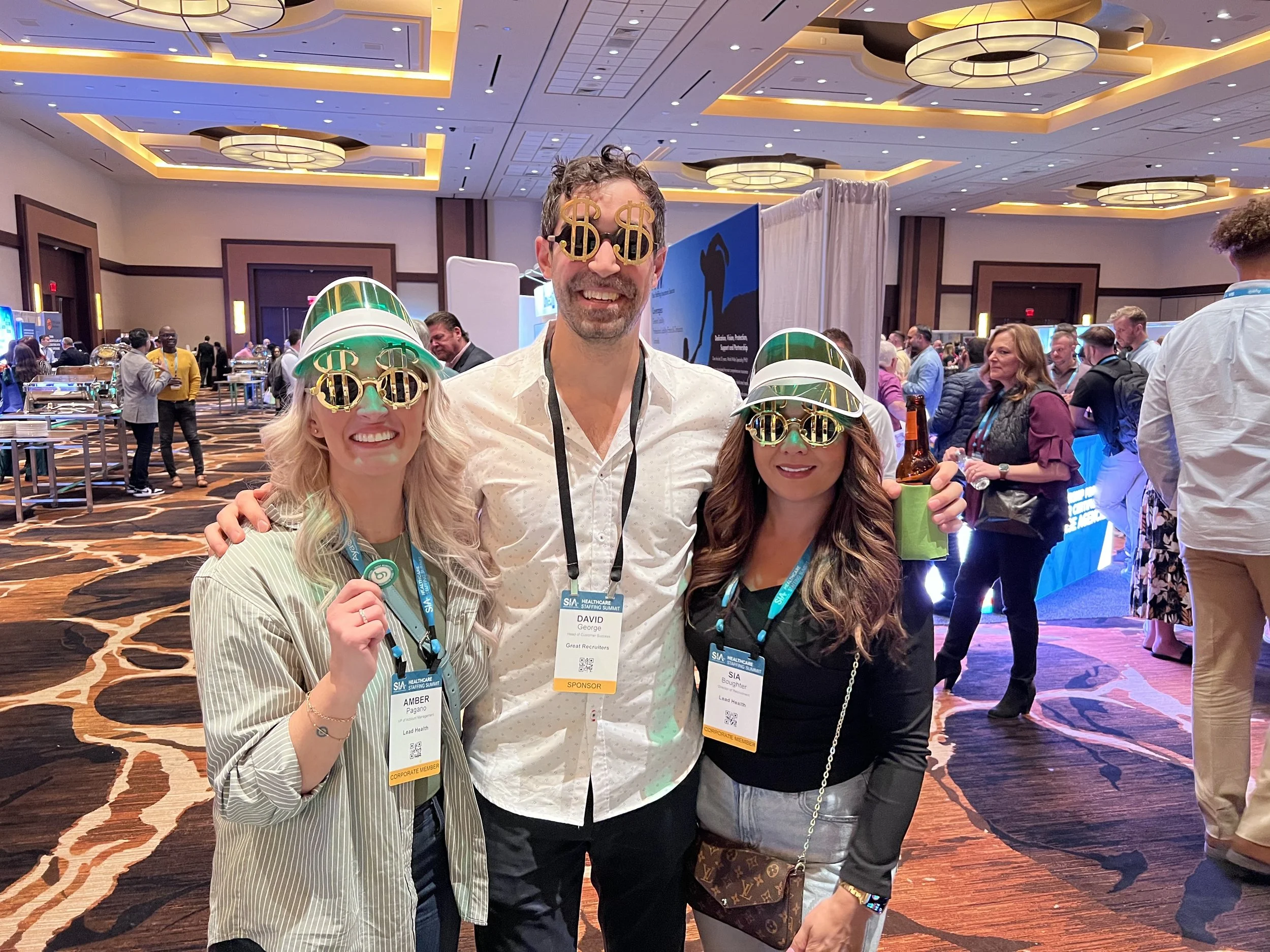
Photo courtesy David George
What does a typical day look like for you?
The days do vary. I am someone who enjoys my sleep, so I usually get up between 8 and 8:30am, pop on between like 8:45 and 9 at the latest. It's a fairly standard 9 to 5. We try to maintain a decent work life balance, sometimes I'm working till 5:30 or 6p if there's a lot going on. Every two weeks is a new sprint where [our development team is] working on stuff for two weeks and then I'll do some additional testing. So every two weeks I have a bit more work to do, probably 2-10 hours of testing depending on the complexity and number of projects they finish. We have a handful of different awards and recognitions that we allocate throughout the year, both on the individual recruiter and the company level. When things like that come up on the calendar, that's a bit more time consuming. But from a day-to-day standpoint, I usually have 3-10 calls a day with customers. Those calls range from anything to onboarding and training. I offer an open monthly training and have a lot of emails.
The staffing industry isn't doing fantastic at the moment. Covid gave people a false sense of what staffing could be, so there's a huge focus–and I think our platform is perfectly aligned with it–of recruiters getting back to the core of recruiting [which is] building relationships with people. During Covid, some of our partners went from having 50 recruiters to 200 recruiters because they had so many people, especially in travel nursing, wanting to [go] get crisis pay [of] $8,000 a week. Standard travel nurses positions are around $2,000-4,000. So the market is resetting [and] our goal right now is [to] make sure all of our tasks are focused on revenue generation.
What’s something that you didn't expect to deal with in this role, but you do?
It’s probably based on the size of our company right now. There's ten of us in total, so [a] fairly small team. I didn't expect to be doing some of that [development] QA testing because I didn't really have any experience in it. But now it's something that is a big part of what I do because I'm the one who is educating and talking to our customers the most about our product and our platform. It's actually a great way for me to learn, test the tool, and add[ed] a new skill set on my end of things.
While you're doing all of this, you also run Motor City Axe. What are the realities and logistics of balancing these two?
Yeah, it is a balance. Initially it wasn't overwhelming. For a little background on Motor City Axe, I started off on Etsy and the first year I think I sold 18 or 19 axes. I think I made like $400-$500. I was like “Awesome, free plane ticket, I'll go take a weekend vacation.” I sold almost 1300 [axes] last year. It's grown, it's been great. I was featured in the Wall Street Journal 2022 holiday gift guide. I sold out of my entire holiday inventory of close to 130 axes in one day.
My mother works for me 2-4 days a week depending on the number of orders coming in. Unfortunately, this year has been slow. I don't know if it's just the economy, but I am below where I was three years ago at this point. So, doing some stuff to revamp the website, get some new designs, and usually the holiday season–October, November, early December– are the best time of the year. As far as the balance, depending on the number of orders and volume coming in, I adjust. There are some days where I, as much as I love my sleep, I will get up and put in an hour or two before starting Great Recruiters in the morning. I will work after. Essentially I have two jobs.
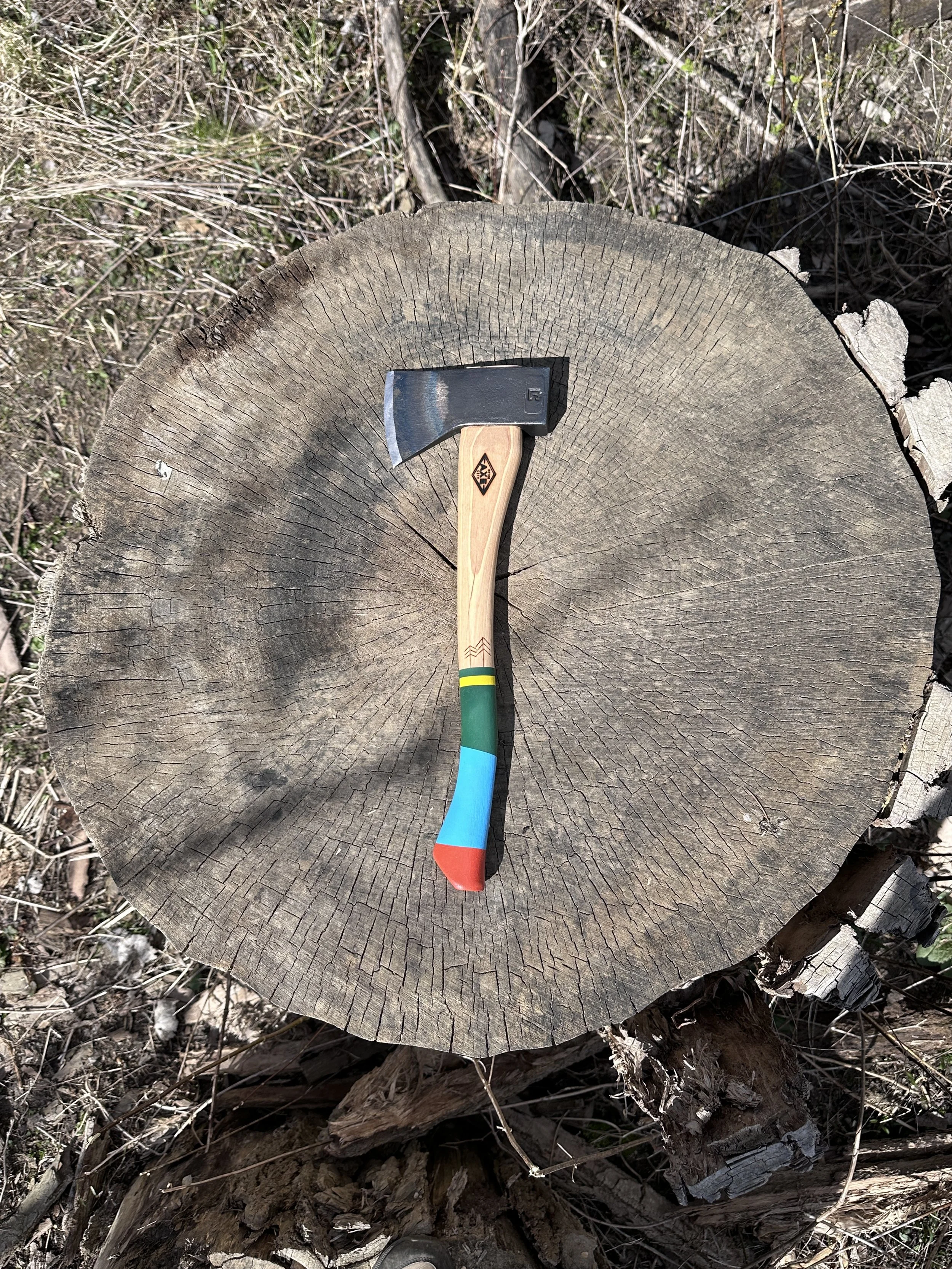
Photo courtesy David George
I try not to do it, but occasionally if I have 2 hours between meetings with Great Recruiters, I'll jump in. At the end of the process for the axes, I put like a sealant on them so they can start to dry, so I can get them shipped later that evening. There isn't too much overlap within the day because I am fairly busy with Great Recruiters, but I will jump on the weekends and do axe stuff as well. In the morning, I'll check my Motor City Axe email before officially starting the day with Great Recruiters.
Are you making all the axes yourself? What is your production like?
There's two lines of the business: we're making and refinishing. I have a handful of people, my parents included, but family friends, my friend's mom, my cousin's wife's dad [who are] avid garage sale-ers. They will go out and grab old tools, axes, any tool that has a wooden handle. I even do hammers, screwdrivers, a full refurbish process on those. Cleaning all the rust off, sharpening, a new handle, make sure the handle is tight and everything is secure. Then I work with a company out of North Carolina who makes all of the new axes for me. I'm just doing the hand painting and design on those new axes, no official forging done on my end.
What types of craftsmanship skills did you have before starting the company and what did you learn along the way?
Back-up to the origin of the company. When my grandpa passed away, [I] found his old hatchet in his garage. I was like, “Oh, man, this is so cool.” I looked it up, it was from like 1917. I didn't know he had it. I've never seen it before. I was like, “This is awesome. I'm going to fix this up and take it camping with me.” So I started watching YouTube videos and researching. I didn't have as many of the tools I have now and even looking at it, it's not that great looking compared to the work I do now.
Once I fixed it up, I was like, “Well now it's got sentimental value. I don't want to lose or break this. I'll go to a garage sale and get another one.” Then my buddy's like, “I want one.” And my other friend's like, “I want one.” That's how I started. I don't know if I had any skills as far as woodworking. I'd done a lot of landscaping work, so [I] was familiar with axes and saws. A lot of it was trial and error. I’ll find stuff at garage sales where I'm investing $100 in something and if I ruin it, then there goes $100. At the start I read online that soaking axes in vinegar is a great way to get the rust off, but vinegar can erode some of the metal and weaken it. I don't use vinegar anymore. Sometimes I would take too much wood off and I'd have to make a larger wedge to fit in the eye of the axe. I have purchased a couple tools over the years, like an industrial size belt sander which I use for cleaning rust and sharpening axes. I have a drill press which is like a six foot tall drill to help with cleanup and putting holes in certain things.
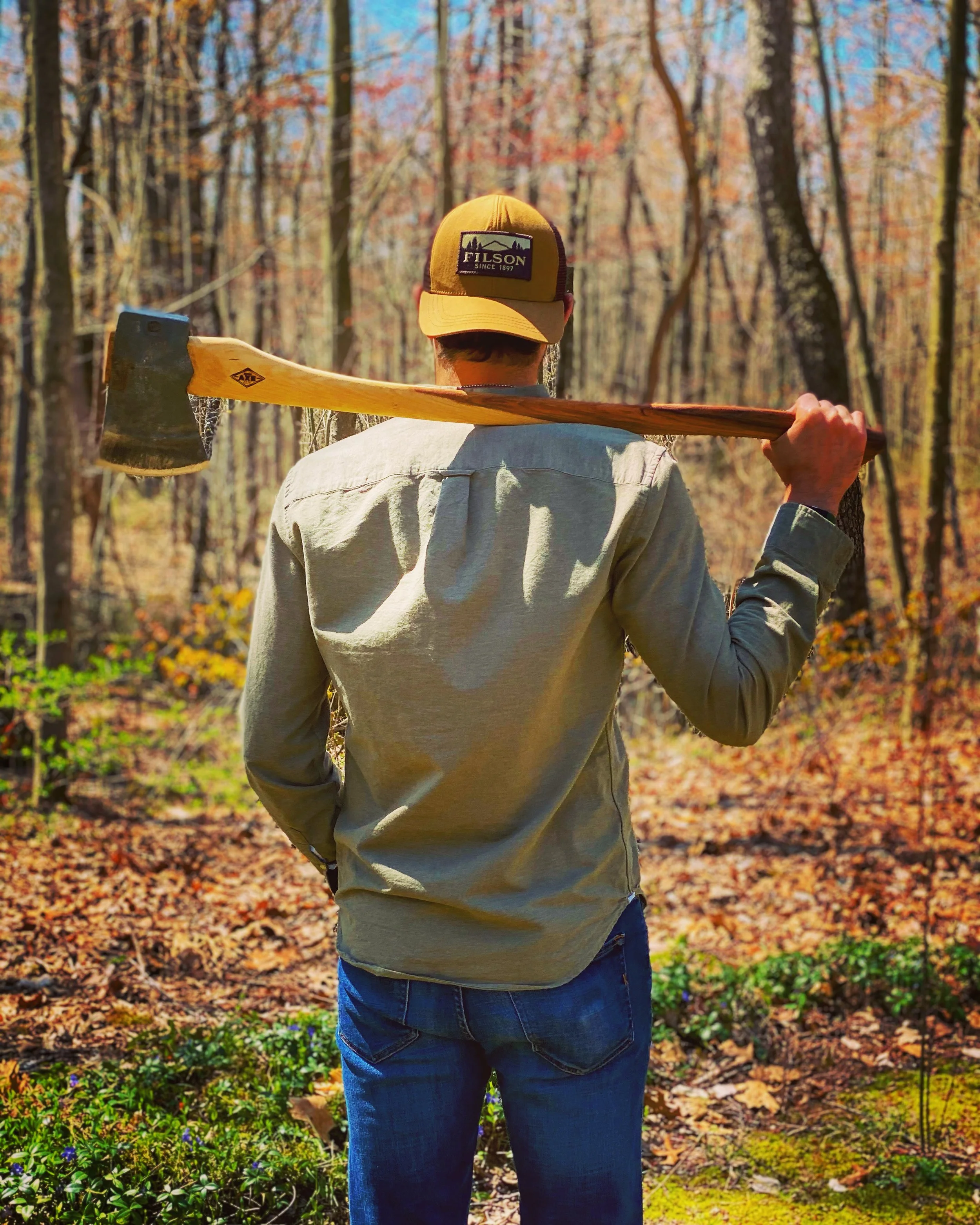
Photo courtesy David George
It started as a hobby and I still look at it that way because in my day job, I sit at my computer all day. I'm on Zoom, I’m in emails, I'm looking at the platform I'm testing. It's all [on the] computer. At the end of the day, some people go from their desk and sit on the couch and watch TV for 4 hours. That's not me. Sometimes after a long day, I can't wait to get into the workshop and put on some music. And while it's work, it doesn't necessarily feel like work. It's still fun. I still have the passion for it.
Okay, but what do you do? Please answer as if you're explaining to your ten year old self.
In my day job, I spend a lot of time building relationships, networking, and talking to people to make sure that they are fully utilizing the tools that are available in the platform for the website that I work for. Then I have my own side business where I get to be more creative. I spend a lot of time working with my hands, playing with sharp objects, and crafting tools and axes that hopefully you and your grandchildren one day will utilize.