Maintenance Technician
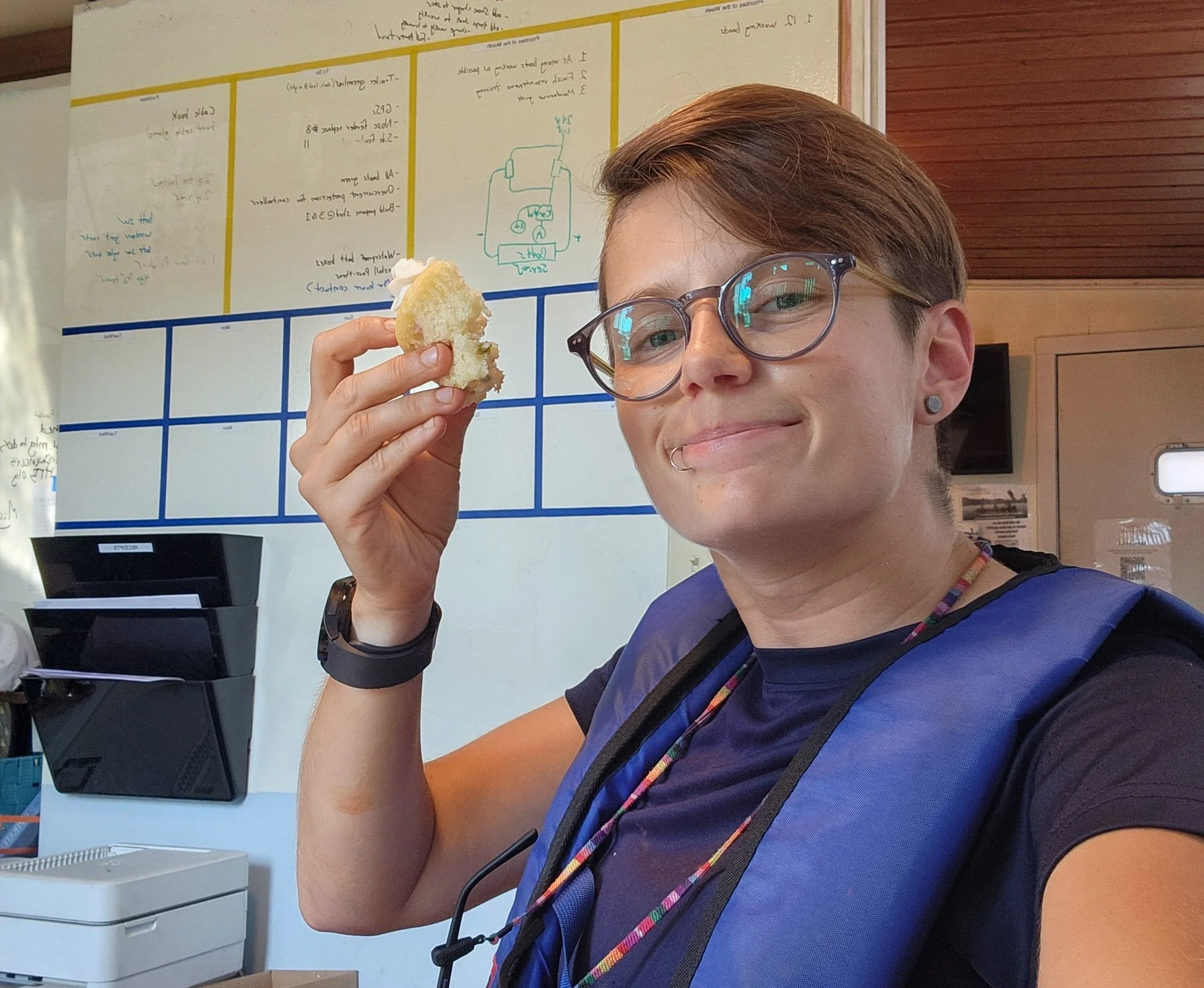
Photo courtesy of Veronica Head
“Maintenance Technician” might sound straightforward, but what does it really mean when you’re working on boats in Seattle’s busy waters? Enter Veronica Head, who helps keep a fleet of hot tub boats running smoothly day in and day out. If you’ve never heard of a hot tub boat, it’s pretty much what it sounds like – a motor boat with a hot tub smack dab in the middle of it. Here, Veronica shares about her role, typical responsibilities, and what she’s learned in this position.
Name: Veronica Head
Occupation: Maintenance Technician
Okay, But What Do You Do?: I work on boats. I build boats and I fix boats.
What is your official job title?
Maintenance Technician.
Can you walk me through your career to date?
When I started out, I was a project engineer for a small construction company in Detroit where they did demolition of blighted and abandoned homes. Then [I] was a project manager for a very small two-person company called Goodbets Group. They worked with nonprofits primarily in the education space seeking funding, helping them with a variety of things. Then I moved into [the] co-founder world and built a cool little product for a food tech startup aimed at helping freelancers that no longer exists.After that, I worked for TAIT [Design Co.], building clocks in Detroit, and then for a company called Leverage, a [midsize] tech startup. I did project management [there] for a while. Basically I asked developers, “Hey, what are you working on today?” I built some apps. I've also freelanced a lot throughout this entire career, mostly to make more money. I've done some freelance web development and app development and fun stuff like that.
I got laid off in March [2024] from the tech world and then found this job at Lake Union Hot Tub Boats. I started out as a crew member. [I] would get boats ready for customers and give them a little speech, get them out there, do a variety of things to make sure everything went swimmingly. Then our maintenance person noticed I was very maintenance inclined, curious, and she was like, “I need more people to do maintenance and be trained.”So I got trained in that and that was cool, troubleshooting a variety of issues [and] doing regular preventative stuff on the boats, like making sure they look good, opening them up, inspecting them, making sure they're nice and clean. I like fixing things as they come up, like fixing and rebuilding a motor and doing a lot of mechanical things.
That's awesome. What was the training like when you moved over to maintenance?
The head [of maintenance] is quite cool. She is [a] former Coast Guard, so [she] has worked in boats for a really long time and worked in more maintenance roles. She came in and very quickly put together a program of, “Given these boats are what they are, I think we should maintain them this way.” She [created] very clear documents like, “Here's what you should do to maintain a boat and here are the common things that go wrong and how to troubleshoot it.” So anytime I shadowed her for a bit, anytime she did preventative maintenance work, she'd be like, “Here's the checklist I'm following and here is what I'm going to do.” And then she had an excellent spreadsheet to track this.
Anytime something went wrong with a boat, she'd be like, “Okay, let's go look at it together. Here's what I'm doing and why I'm doing this. Here's generally how you would troubleshoot and move through a flowchart of things.” Another cool bit is that this summer, the company bought new boats. The boats come from the Netherlands as a shell of a boat and some parts, and then we have to put the motors in it and do all the electrical wiring, assemble everything, get it good to go. So that was cool because we got to build boats together.
What kind of mechanical systems are used in the boats?
The boats are electric, so no gas [or] oil stuff going on. They have batteries that power the boat and then those get wired into an electrical charging plug that plugs into something on the dock to charge the boat.They have navigation lights, so there's lighting that's been wired throughout the boat, and then it has these two electric motors at the bottom of it and a rudder in the middle, so that's how you steer the boat, you push [the rudder] one way or the other. The motors are little– they look like bullets basically–with a propeller on the ends and something that spins.
They are induction motors, if that is familiar. Basically, [they’re] like a giant magnet. When you push electricity through it, it spins something like a shaft in the middle and that's what actually spins the propeller. So you electrify these magnets and they spin. And then what else…? There’s wiring and components to control the motors. The customer will actually see just a little black knob on the boat that turns forward or backwards. And that's what sends a signal to two motor controllers inside the boat to go this direction, go this fast. They're just moving a little knob back and forth, and it controls [them] electrically, which is really cool. [The hot tub inside the boat] holds water and we use a pool heater to heat the water up. But while they're out [on the lake] there's a big metal stove at the front that keeps the water hot. So there's also fire, it’s another system on the boat.
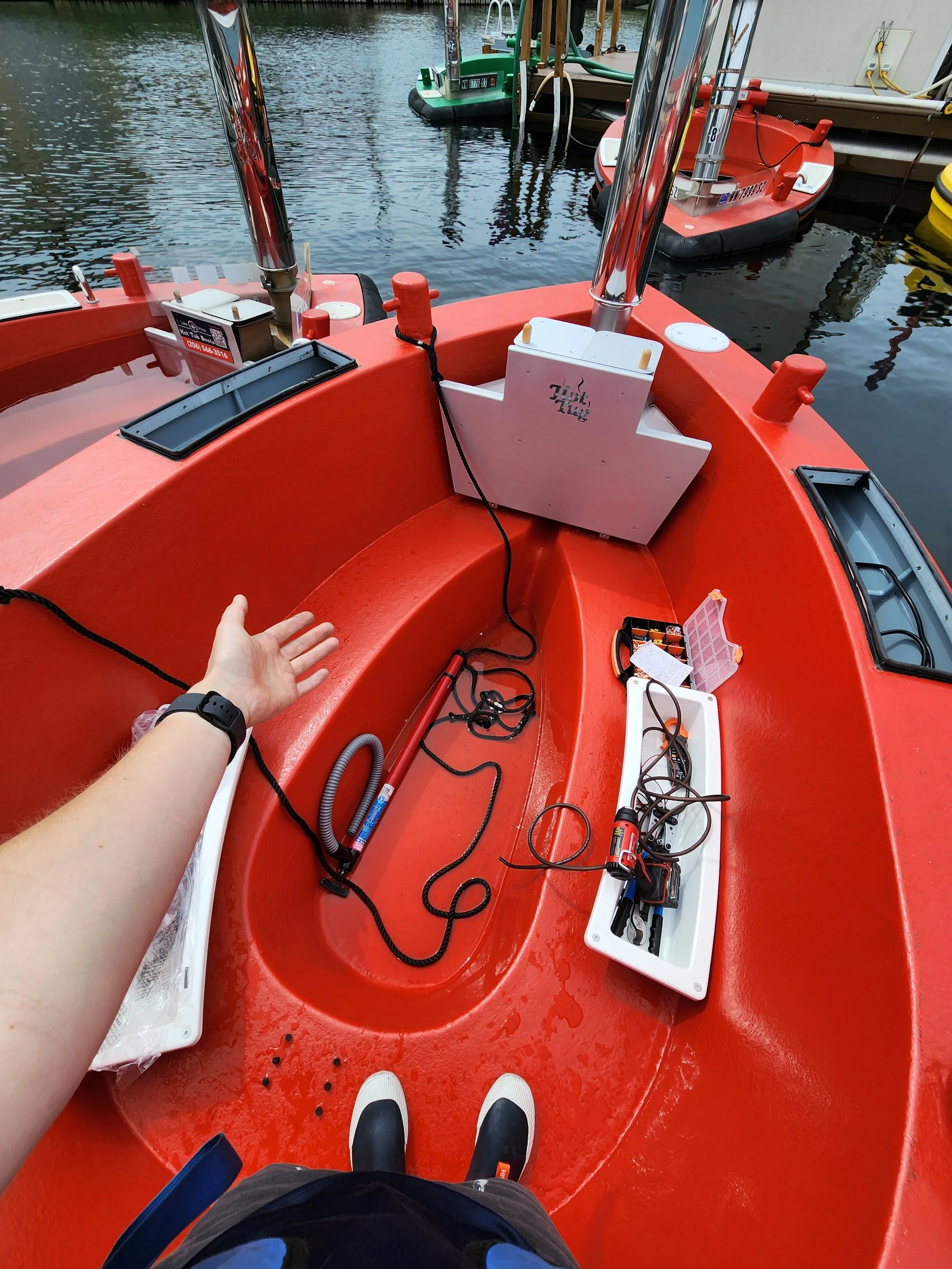
Photo courtesy of Veronica Head
What kind of maintenance are you doing most often?
I’ll [do] a bi-weekly inspection. That's just, open up everything on the boat, look at it, make sure it's dry, make sure there's not any issues, nothing looks wrong, [that] there's not, like, a melted wire. The most common issue is the motor going out, because the boat is heavy and massive, and the motor is meant for little fishing boats. And they have these metal–they're called brushes, but [they’re] little metal blocks–inside of them that just naturally wear it out as they get used. So it's very common for a motor to go out. And that's very simple, we just take the boat out of the water, take the motor off the boat, put a new one on. Then we'll take that motor inside and open it up completely. There's two large screws on it. You open it up, and kind of look at, like, okay, what's wrong? Did it just wear out? Is it wet? Did something bad happen to it already? [If] the part is bent and then broken, [we] refurbish it, clean it up, put new brushes on it, get it good to go, reassemble it, test it, and then put it on the shelf for future use. Sometimes there’s drunk customers [who] grab the light, and it falls off, and that's like, “I’m just gonna screw it back on.” Small things like that also happen.
What types of tools or equipment do you use most often for this?
I'm gonna say a drill. Cause most commonly we're opening [the motor], undoing the screws on it and looking inside. What else…? We built a little lathe [a machine tool that can shape materials like wood and metal] almost, to refurbish the armature, or the central part of the motor. I thought that was quite clever. Our coworker built it, just a little wooden stand, and we can use the drill to spin the inside of the motor and then refinish it on the lathe, essentially. So, the cheapest lathe that was ever made. What else…? We do some wiring. So, run the wire, strip the wire, crimp an end to the wire.
What does a typical day look like in this role?
During the week, we run ten hour shifts, which is a little wild, but the place is open from noon to 10pm on a weekday. On the weekends, they’re open from 8am to 10pm, and they run [on] shifts. So, 8 to 3 [and] 3 to 10. It depends. [I] come in, look at the schedule, assess, get the boats ready, but it's just a little different [everyday]. We look at the state of the boats, like, “Did a boat break last night? Does anything need to be fixed?” Test all of the boats to make sure these all are working. [If] we need to access a boat, I’m gonna go get the truck, get the trailer, get that boat out of the water.
Something kind of cute and fun that I've been working on recently is, there's a tiller handle to move the rudder that you use when you're sitting in the boat, and a lot of those have gotten wet or damaged or rubbed down over time. I've been taking them off and refinishing them and painting them [with] really fun, cute patterns. There's one [that] looks like the Toy Story bedroom ceiling, it's got little clouds on it. Right now we're working on one boat that we got fully repainted and refinished. It's very pretty, and now we're gonna put some new parts on it, really make it nice, and then put it back in service.
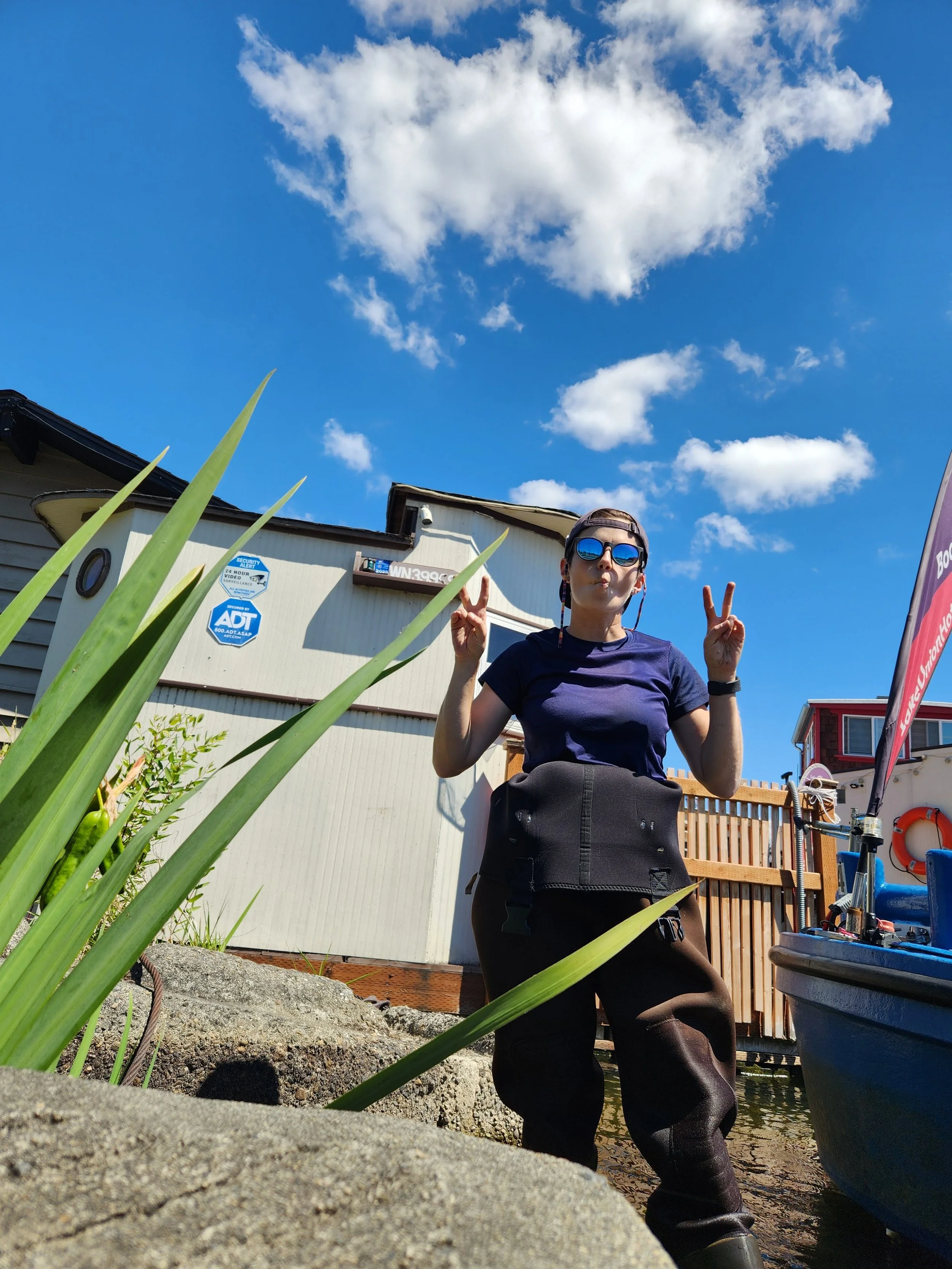
Photo courtesy of Veronica Head
What are the typical career options within this area?
This is a small business. Career advancement here would essentially be to maybe eventually become my boss one day, manage the whole maintenance program, but [it’s] a bit limited because the [company is] so small. Normally, this is very trade-centric, so the way it'll go is you'll be an apprentice, then a journeyman, and then slowly work your way up to a technician.
What skills do you think are most needed to succeed in this role?
I think the hardest part is the mechanical inclination or troubleshooting mindset. Whenever something goes wrong electrically, you need to isolate things and work backwards in the system to see where that problem comes from. That's an interesting mindset to adopt. I think you can learn this problem solving ability, looking at [things like], “Okay, I know it's meant to work like this. So let's see, what are the steps? And at what step did it go wrong, or does the condition change?”
What's the most difficult repair you've had to perform?
This is partially because I was feeling lazy, but I had to do this repair: the rudder has that cute wood tiller handle at the top and then a long metal rod that goes down through the boat to the water. And at the end of that, there's a slot in the rod that a rudder, a giant metal plate, goes into. It gets screwed in two places. A customer had broken off the rudder. You can fix this while the boat's in the water, but it is not as easy as pulling the boat out.
I didn't want to get the trailer, put [the boat] on the truck, drive the truck, get the boat out…lots of steps. So I just pulled the boat aside in the water and I was wearing rubber waders and sitting there trying to fix it. But the rudder shaft wasn't perfectly machined, so the spot was not big enough. So I was just sitting there underwater with a file, filing this piece of metal down so that the thing would fit. It took way longer than it should have. So, something that should have been way simple ended with me sitting in the water with a sledgehammer and a file, just trying to get two pieces of metal to fit together.
What's your favorite and least favorite part of this job?
I would say favorite and also sometimes least favorite is being outside all the time. Delightful when it's not Seattle [typically wet and rainy] outside. Summer was beautiful all the time. [But] terrible when it's 40 degrees and it's raining and your hands are wet all the time. Also, some customers, [are] really fun, lovely. Some customers [are] drunk idiots and not the funnest people to be with.
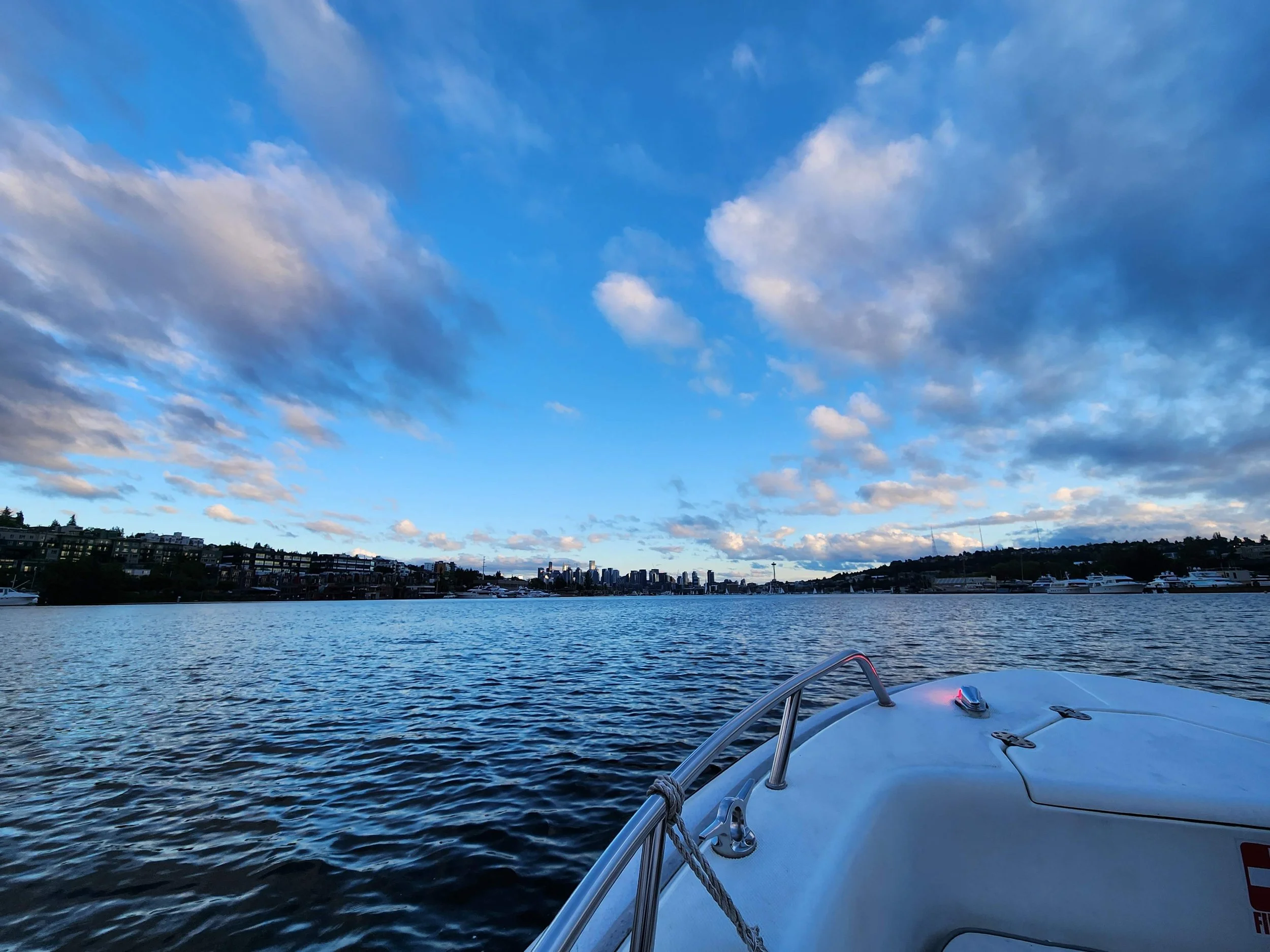
Photo courtesy of Veronica Head
What is something you didn't expect to have to deal with in this job, but you do?
I don't know that I expected to deal with so many electrical things I've never seen before. I mean, it makes sense the boats are electric, but a lot of it is electrician-esque, which I was excited to learn, but also kind of terrified of. I had to do work on one of the buildings [in a past role] once, and I was like, “I'm shutting everything. I don't want to die of electrocution. Nothing's going to be on. Everyone out of the building.”
Okay, but what do you do? Please answer as if you’re explaining to your ten-year-old self.
I work on boats. I build boats and I fix boats.