News Editor and Podcast Host
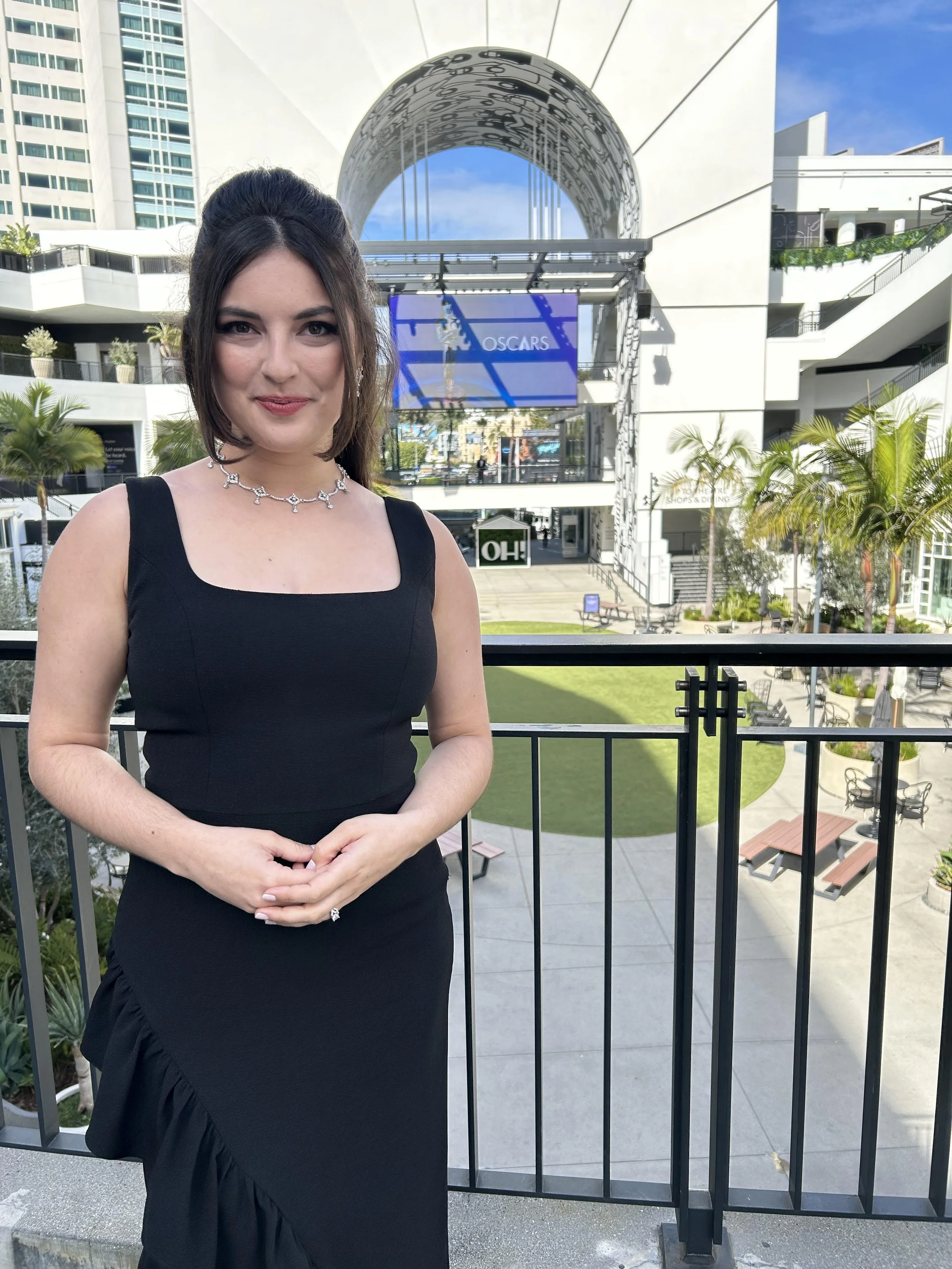
Photo courtesy Erin Ben-Moche
Lots of people read the news to stay up to date with current events. But what’s it like to work on the other side of it, in the newsroom? How does the news get made in the first place? We spoke with Erin Ben-Moche, an award winning journalist, to find out.
Name: Erin Ben-Moche
Title: News Editor & Podcast Host
Okay, But What Do You Do?: I tell you everything that happened in the world today.
What is your official job title?
I am a News Editor at KFI, which is an AM radio station for iHeart [Radio] in Los Angeles.
Can you walk me through your career to date?
In college [I] stud[ied] journalism and entertainment. I really loved film and television, and I was always trying to figure out how to make that a career. In college, I was working in the radio station, writing music reviews, doing a music show. And then sophomore year of college, I was covering film festivals. So [whenever] my boyfriend at the time–who's now my husband–would go to a film festival for his movie[s], I would try and do press for that film festival so we could both be there at the same time doing the things that we liked.
I just did that a lot. I was freelancing random gigs for random festivals. That's how I was able to go to the Hamptons festival and the Cannes Film Festival. Then when I graduated college, I moved to LA and started doing digital news for the Jewish newspaper in LA [The Jewish Journal]. I [became] their entertainment correspondent there, and so I got to do some cool red carpet events and movie premieres and features on different Jewish artists. And then the pandemic happened, and I ended up finding my way to KFI, which is where I am now.
I love that. So, what drew you to journalism?
I have no idea. I was just talking to my husband about this because if you met me in high school or even early college, I was a theater kid. I was gonna be on stage [or] be in front of the camera. And I think there was just a moment where I was like, “You know what? I love this, but I love talking about it more.” I love performing, but I love telling people why they should care about this show or why they should care about the film [more]. So I started falling into covering the show and understanding what made it art instead of being in it. And then ironically, I still ended up getting to do performance stuff in my adult life and [performing] on a Broadway stage.
But with news and journalism, there's something really powerful about working in an industry that's always changing but always important. Most of my day is hard news, local and national and being able to know exactly what's going on. It's a lot, but it's incredible to know, like, “Hey, this is what's going on in our local elections. Hey, here's what's going on in the environment.” Every story you write has to be digestible for people, and getting to communicate a message to a lot of people is really cool. I think it's kind of a performance, too, right?
You have to become an expert in something, and you're playing [the] role of someone who knows a lot about national security, even though you have no idea what that is. So it's exciting. You never know what a day is going to look like.
You’re also a podcaster. Do you consider that part of your official job title as well?
It's a side gig, I guess. My day job is being a news editor where I'm editing stories, writing stories for radio. But then in my spare time, I'm also podcasting. I do a Jewish pop culture podcast called The Bagel Report that started four or five years ago. My friend and I were sitting in a board meeting at a nonprofit newspaper, and we kept giving each other funny glances and looks from across the pitch room. We realized we love talking about entertainment and tv, and anytime there's something Jewish in there, Jewish representation on screen: what does that mean and what does that look like? There's a lot of people who talk about Jewish media, but there aren't a lot of people in Jewish media who are women. We got together every week and were in the studio for maybe a month, [when] the pandemic happened. So we've been doing it on Zoom ever since, just the two of us.
Is it attached to KFI or The Jewish Journal, or is it independent?
It used to be in the beginning when we were both working at the Journal. It used to be hosted there, but now we're independent. Now it's run by ourselves. If anyone wants to collaborate with us, we figure out ways to make it happen. We're just two independent bagels, interviewing people and talking to people. And what's also really cool is lately we've found ourselves interviewing Jewish pop culture educators who literally spend their day teaching basically what The Bagel Report does, but as a college class. We talked to a guy from Stanford who talked about Jewish representation and antisemitism. We also talked to this amazing woman a couple months ago about what [an] unapologetic Jewish woman is because she wrote a textbook about it. It's just really cool when you can find people to geek out about pop culture [with] and find an intersection with your Jewishness. So that's also part of my job.
What's the process to put together an episode of The Bagel Report vs a story for KFI?
Well, they're two completely different mediums. [For The Bagel Report] we spend about 5 hours a week on the podcast production. It's [about] 1 hour recording the podcast start to finish, and then we try to edit it down to about 40 minutes. Sometimes we're not successful in that. We have a lot to say, but we do prep. We have a huge Google Doc of ideas and possible guests and dates and releases of shows and movies coming out. And then we get screeners for them. That way we can always time what we're doing. Then we watch the content and bullet point everything.
There's a lot of back end work that we do to make sure that what we're saying is not scripted, but we kind of know, “Okay, you're going [to] touch on this thing” so we don't have to repeat ourselves over and over again. Then it takes me a couple hours to edit it all down and mix it together. I use Audition. Some people use Audacity to audio edit. Then I upload the episode and it goes out that week. It's a lot of nights or early mornings figuring it all out. Sometimes we don't have an episode. We're super busy and we don't do one that week. And sometimes it's super busy, and we'll do two in a week. But that's the turnaround for the podcast.
But for KFI, I probably edit like 20 to 30 stories a day, and our stories are 30 seconds long, max. We basically zhuzh headlines because you're in the car. Like, we write for the mom who has kids in the backseat, and you're trying to make a left, trying to get to the place and remember all the things you forgot at home. And then all of a sudden, oh, yeah, you're listening to the news because you have to know what's going on today. It's a chaotic way to tell you the news. So it's super simple and we put together a lot of mini clips. We're editing sound. We're editing news stories. We're doing our own news stories, compiling them together and then sending them to the air. It's like we're in the minute business. We do the news at the top and bottom of every hour. So, 5:00 and 5:30, and then we do 5:15 and 5:45. Super quick clips.
That's so many a day. But that makes perfect sense in this context. I wasn’t sure if you were the ones on air or not.
It's a mixture of everything. Sometimes reporters are filing stories to us and we're asking them questions and making sure they have all the components they need. Sometimes we're on the phone doing interviews with local experts to get local sound on the air. Sometimes we're rolling on a big press conference. Every day we have no idea what's going to happen, which is exciting.
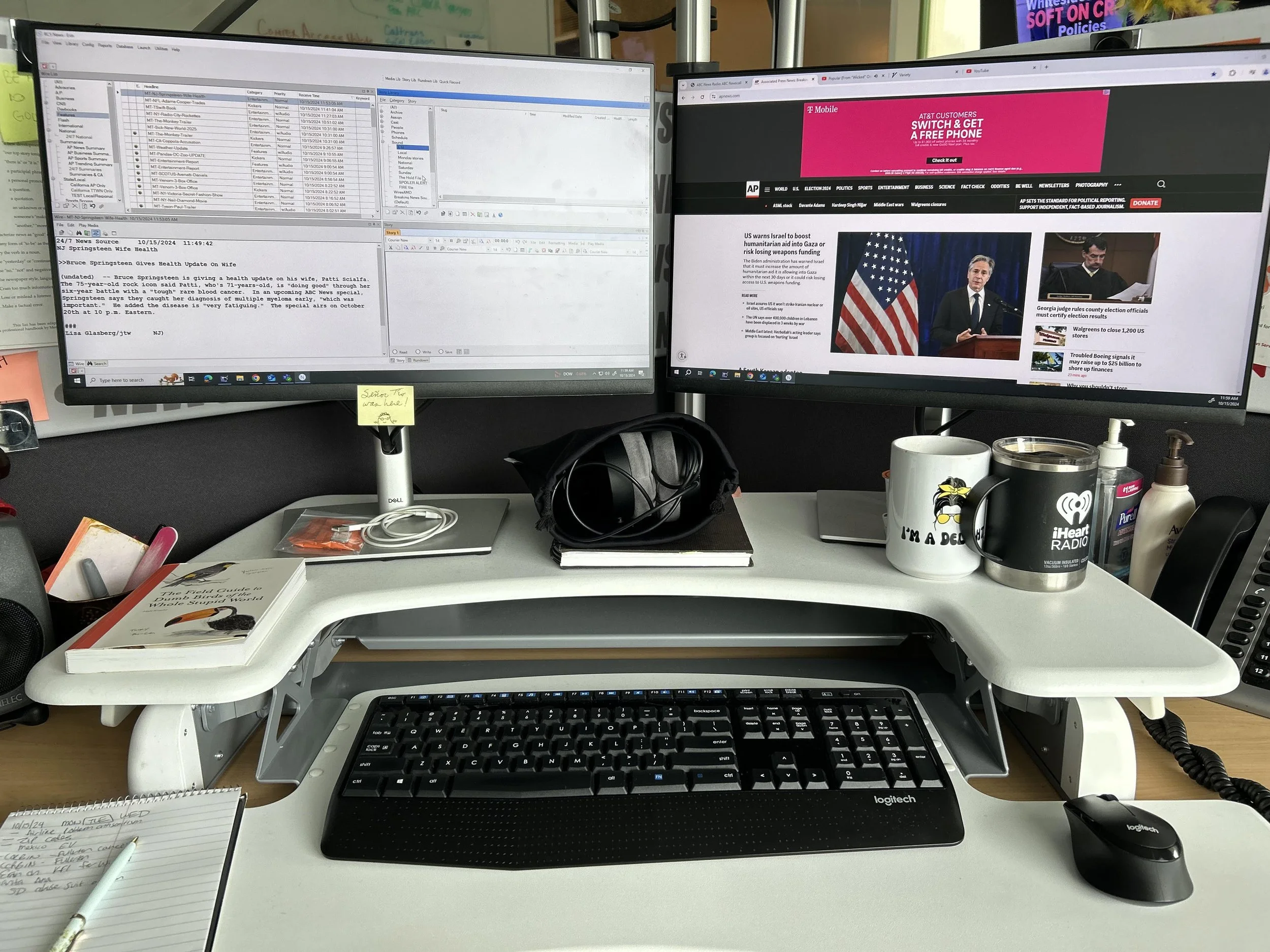
Photo courtesy Erin Ben-Moche
How much of your time at KFI is usually spent doing each aspect, like finding the story, recording it, editing it, or other tasks?
It changes every day. We have a lot of wires to pull from. Sometimes we get a lot of raw copy, which is super dense press releases or statements from people's calendars or whatever. So we have a lot of stuff to consume and we're reading the story and then regurgitating it in a really simple way. We have, like, 6 TVs in the room so we're watching local news, national news, for 8 hours every day just so we can see what the big stories are and then consolidate them and figure out what our audience needs. But sometimes we have about a minute to get a story on the air, so it is pretty quick.
How do you hear about the news first to be able to report it?
Sometimes we get a tip. Sometimes we'll literally get a call from our own listeners. They'll be like, “Hey, there's a fire.” Or we'll get a tip from Twitter. We'll see, “Hey, someone tweeted that there's a lockdown in school. Let's call [the] school. Let's call parents. Let's see what's going on.” Sometimes we see TMZ report something ridiculous, and we're like, “Okay, is there any validity to this?” Sometimes CNN will report something, and then we will verify it and run with it. And sometimes it's like, “Hey, I've been thinking about this thing, right? I wonder if this is a big trend.” And then you create your own story with your own statistics. Or, “Hey, there's a big movie opening this weekend. Let's go down the street and interview people.” So it depends. Sometimes you're creating it yourself from scratch, and sometimes there's a guide post.
That movie one sounds like fun.
Yeah, sometimes you get a good time. This past year, I got to go to The Oscars, which was huge. It was a big life goal of mine to go, and it was really fun getting to do the digital side of it, upload pictures, what's happening behind the scenes. Because you're in radio, it's not like they're gonna [want to just listen]. There's a lot of visual stuff, so it's more being the eyes and ears for the listener who doesn't really get that visual element. That adds a fun little surprise and challenge to the job.
Of all the different news formats, what drew you to audio and radio?
I've done print, digital and radio. I guess I love radio just because the vibe is great. Radio people are the best. They're so no nonsense. It's such a grungy environment. We're here to do the news. We don't need to be glamorous. We don't need a whole TV makeup crew. It's very scrappy. It's really amazing what AM radio people can do when you don't have the same amount of resources as a monthly magazine or a major network. We're part of iHeart, but we're still AM radio, which is going through a really interesting moment right now because everybody's going to streaming and podcasting. We're still such a strong station and the news is top quality and we still have great bandwidth, all things considered. The grit of radio is just really fun and wacky.
Plus, every show is different. We're talk radio, so you can listen to any show at any time and you're gonna get a different sound and a different audience. You don't really get that with TV or print. You don't really get to have a personality or a team of wacky people when you're doing TV news. We're the news division, so we're not really associated with the shows all the time, but every once in a while they'll give us a shout out and we'll have some fun. The crossover is just really nice, and it's a cool environment.
That sounds really special.
Yeah, it's pretty fun. I'm pretty lucky.
If someone is breaking into the industry and thinking about news in general, what are all the different roles that they could consider?
That is a great question because news is changing. It was changing when I was in school. I graduated in 2018, and it is already so different. Every day, papers are closing, new publications are opening. [For] getting your foot in the door, be open to doing anything. If you want to be an editor, if you want to be a writer, have a beat. Have something you're passionate about. Being a chameleon is one of the most valuable things you can [be] in this industry because if you are just a one trick pony, you are so limited in an industry that is changing. Even AM radio. I can't believe I work at AM radio. It's crazy. It was ancient when I was a kid, you know? Everyone listens to FM, right? But people don't even listen to the radio anymore. People listen to podcasts [and] playlists and Spotify and music. They have their own curated thing. So, knowing how to carry a conversation, how to interview, how to edit, all of those things are so valuable. Knowing how to book and produce and create segments. I think that will really lead to success.
What are the tools you use the most as a news editor?
In college, one of my professors said to question everything. If your mom says they love you, question it. Say, like, “Says who? Show me the proof.” In life, I am such a trusting person, but the second I'm working, I question everything. [Even] spelling. Every piece of content, I give them the benefit of the doubt. But I'm like, “Okay, an idiot wrote this”, so I have to just pretend that everything is in question, because you have to make sure the facts are right. You have to make sure that the context is there.
In radio, the way you read something is not the way you say something. A lot of people don't know how to say certain things or people are from different parts of the coast, so people have different accents and emphasis on different syllables. As an editor, we're the gatekeeper. So it's basically like, “Okay, I'm just checking–this is what you mean, right? Good.” Now I can defend it and pass it on so the anchor can read it without a problem. I think that is the craziest part of the day, just making sure that everything is right. People don't trust the news anyway. So when you're wrong, they'll never forget it. You really have to make sure that the way everything is being communicated is completely accurate or as accurate as can be.
Sometimes we'll spell things incorrectly because it's easier to say. Just so you don't trip up when you're reading the story. It has to be conversational. If you get tripped up all of a sudden, people get taken out and they might turn the channel. It's not just being accurate in the news, it's being accurate in the delivery and making sure that biopic is spelled bye-o-pic instead of biopic. Or, Mayor Bass is not Mayor Base. We had a conversation a couple weeks ago about how [to] say Kamala Harris's name because she's a Vice President running for President. Some people still don't know her name, some people are making fun of her name. But we have to make sure that, as the news, we are saying it correctly.
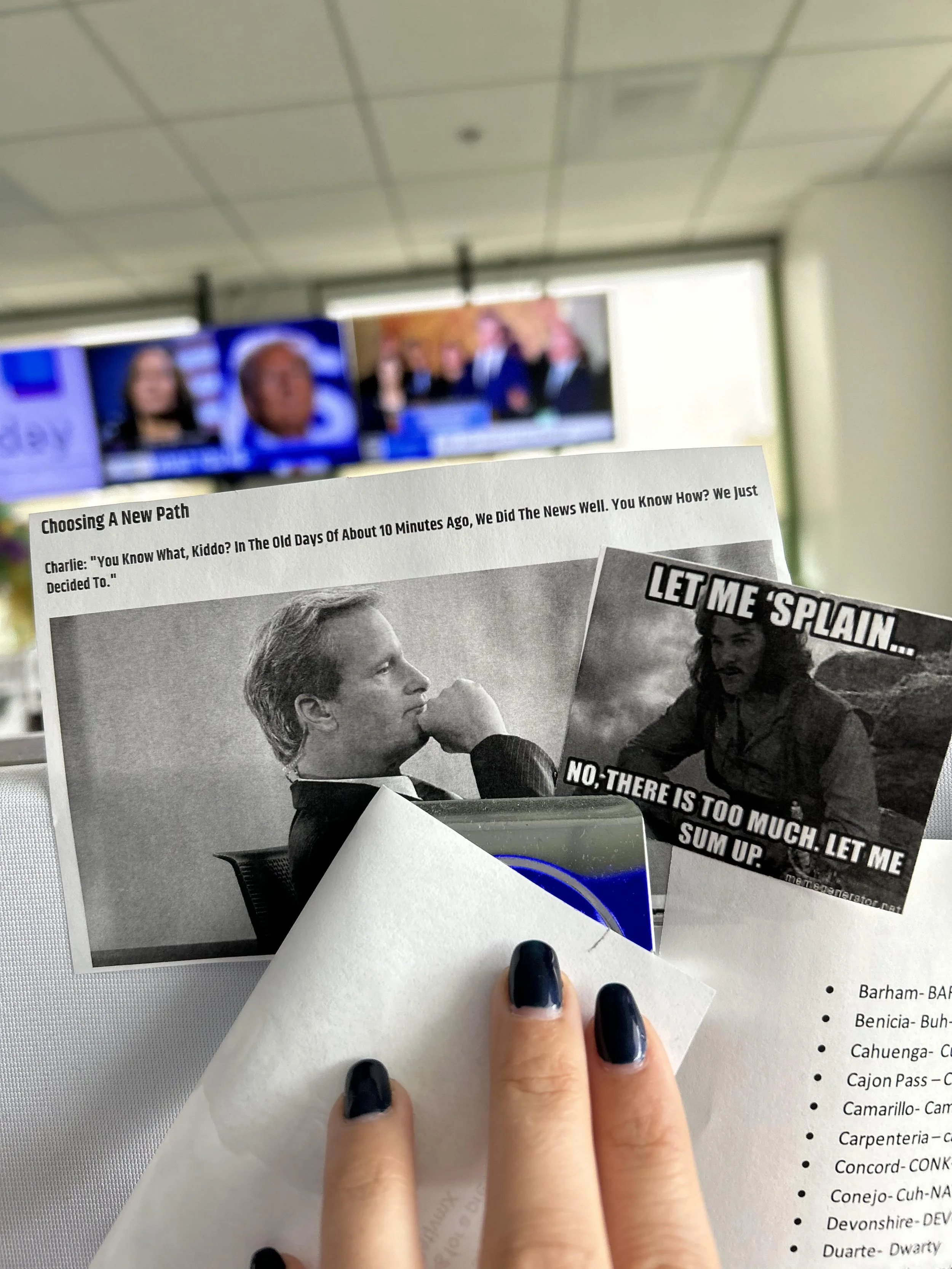
Photo courtesy Erin Ben-Moche
What's your favorite and your least favorite part of this job?
My favorite part is learning about something new every day. I think sometimes that is the best and worst part of the day because there are times where I know so much, and then it's like, “Oh, I know everything”, and it's a lot. But I think being able to learn about the world and what's going on and knowing the names of politicians and different legislators…sometimes I feel like I'm an Aaron Sorkin character that I have all this knowledge, and then the second I leave, it just gets washed away. My husband will be like, “What was in the news today?” And I'm like, “I couldn't tell you. I have no idea.”
What's your least favorite part?
The worst part of news is that there [is] someone who doesn't want to pay for it. Journalism is protected under the First Amendment, [but] the world is becoming more digital, and so the fight for legitimate news is difficult. Making sure that you're not just doing what advertisers want or having some giant corporation buy you and then sell you for parts, that's rough. Because I am working in a new journalism world where I hear every day about the glory days and what it used to be like, that's difficult. [At] both of my internships, I worked at the Chicago Tribune and the LA Times, amazing news organizations. But when I was an intern for them, they were being sold or they were joining unions or they were moving from a historic building to a new building. They were going through a new transition.
I think that is the rough part of the job. It's convincing people that your job is important and it has to be local and you need seven editors. You don't need three. You need seven because you want to make sure it's absolutely right. You want to make sure you're being thorough. We used to have two papers at one point, one in the morning and one at night, and that doesn't happen anymore. Local news is so important, and sometimes people don't care, they just want something that's free. And when they hit a paywall, they're willing to sacrifice the quality of the news just in order to get something, and then everybody suffers. That's the rough part, knowing it's an important job, but you have to fight to prove that it's important.
That must be incredibly frustrating. Local news is very important!
Yes, it's important. It's so funny to me, the thing that makes me laugh is when people are like, how come the media isn't covering [this], or no one is talking about this. I see it on TikTok all the time. I hear it from my friends. As someone who sits in a newsroom with 6 TVs, with CNN on 8 hours every single day, we're talking about it. You're just not seeing it because you either don't know where to go, or your echo chamber isn't giving you that information. It cracks me up. The news is out there. There is information, and there is new. Not people sharing stories and experiences, that's something else. You just have to know where to look for it.
We rely on social media to get news alerts. But with social media changing now it's difficult because you don't know who's verified and who just paid for it. Social media is challenging, but [it] still a tool for it for journalists. I [just] don't think it should be where people are getting the news, you know?
For sure. What does work-life balance look like in this role?
Work-life balance is working and not bringing the news home with you. It's watching something else or doing a podcast or finding a hobby, something that isn't the news. If you're only in the news, it can really bring you down, like doom scrolling, but educated doom scrolling, which is worse because you're like, “Oh my G-d, there's so many problems and we have to fix them all. And how are you going to fix them all? You can't fix them all. So I guess we're just not going to fix anything, and that's not great.” We do a lot in our free time. We hang out with friends, we read, we do other things and get away from the news. At least I try, [I’m] not always successful.
Last week, I went to the dentist and I was stressed out about the procedure. They said, “Oh, you can turn something on the TV if you want.” I turned on CNN because that calmed me down. Sometimes you have to lean into it. But for the most part, work life balance is coming up for air and making dinner and not watching anything. Not checking the news, not checking your email, just debriefing.
Absolutely. What are your hours like at work?
I [used to] start at 2:00 p.m. to 10:00 p.m. and now I'm at 10:00 a.m. to 6:00 p.m., which is more normal. But when I'm podcasting, sometimes I work in the morning or I come home at 6 and then dive right into the podcast. Sometimes when I'm singing [on stage in LA], I'll take an earlier shift so I can get across town to do a gig. So it changes. But luckily news is flexible and I have the ability to change my hours if necessary.
Okay, but what do you do? Please answer the question as if you’re explaining to your ten-year-old self.
I tell you everything that happened in the world today.